
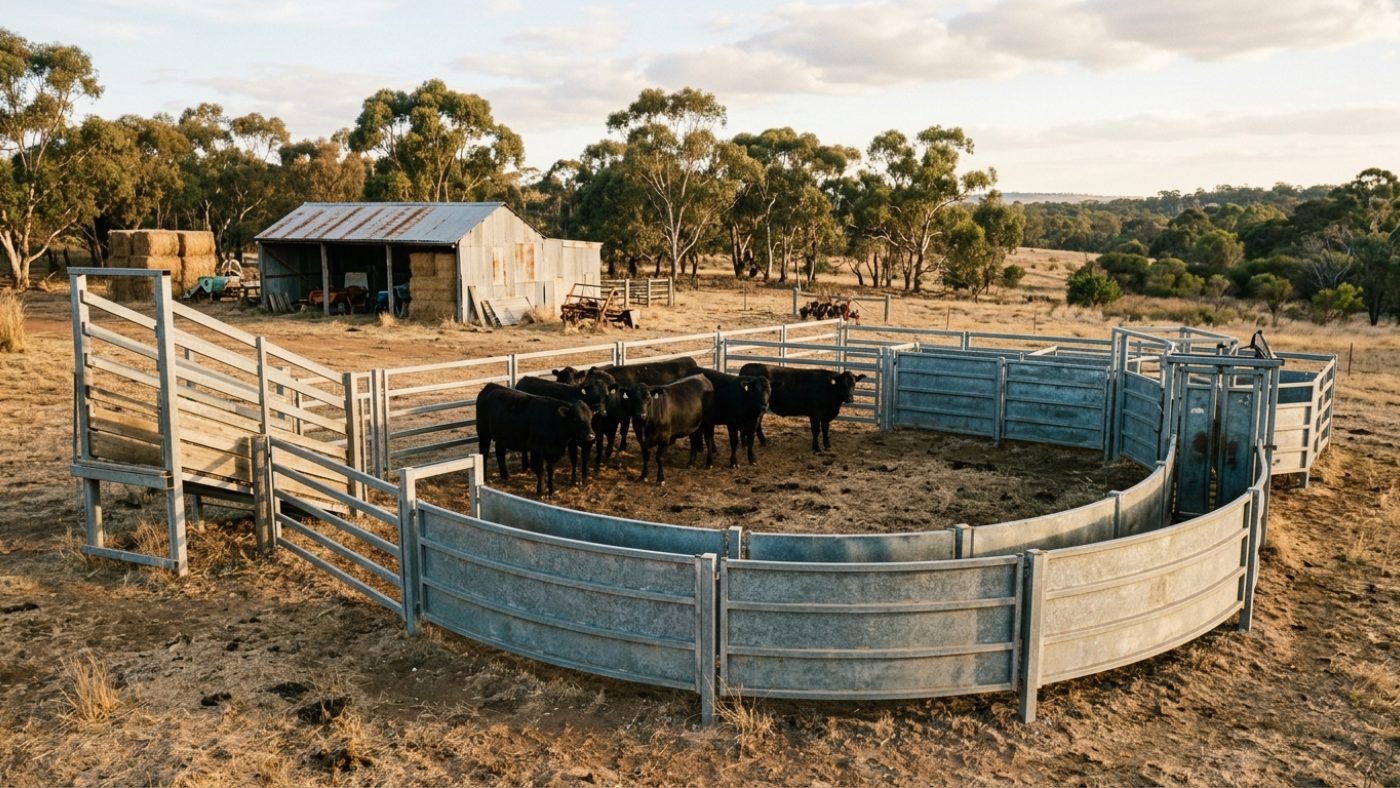
You can keep cattle without yards right up until the moment you can't. Then a vet needs to see a cow, or a truck is coming, or a calf has to be tagged before it leaves the place — and you discover that a rope and good intentions are not a handling system.
The good news is that a small herd needs far less than the yards you see on a station. This is what is genuinely necessary, what the government design guides actually specify, and roughly what it costs.
Why you need yards at all
Under the National Livestock Identification System, every beast must carry an electronic NLIS tag in its right ear before it leaves your property, and there is no exemption for small herds. Agriculture Victoria's rules, updated 1 July 2026, are blunt about the scope: you need a movement document to send cattle to another property, a saleyard or an abattoir — or to give one away as a pet.
Tagging means physically restraining the animal. So does drenching, vaccinating, pregnancy testing, treating a foot, or letting a vet do anything at all. That is the real argument for yards: not efficiency, but the ability to look after the animals you own.
The five components — and the two you can skip
Agriculture Victoria publishes a design specifically for herds of 10 to 50 head. It lists a holding yard, a forcing yard, a race, a loading ramp and a crush or head bail. For a small beef operation it says a head bail on its own is sufficient — a full crush is not essential at this scale.
In practice, the priority order for someone starting from nothing is:
- A holding yard — somewhere to put cattle that isn't the paddock.
- A forcing yard and race — how you get one animal out of a mob and hold it still.
- A head bail — how you restrain the head to tag, drench or let the vet work.
- A loading ramp — needed the day cattle leave. Until then, a neighbour's ramp or a hired portable one will do.
- A crush — genuinely useful, genuinely optional at this scale.
The numbers that matter
Queensland's Cattle yards: design, materials and construction manual is still the reference hosted by FutureBeef, and it is where most of these figures come from. It is a 2006 third edition, so treat it as settled engineering rather than breaking news — but the geometry of a cow has not changed.
| Element | Specification |
|---|---|
| Holding yard space | 2 m² per head (2.2 m² in a receiving yard, 2.5 m² in a cooling yard) |
| Race width | 680–700 mm internal for a vertical-sided race; a V-race tapers from 450 mm at ground level to 690–700 mm at 1 m |
| Race length | Minimum 3 m for 1–10 head; 12 m is the practical maximum even for 300+ |
| Forcing pen | No wider than 3.5 m, 4–6 m long, meeting the race at 30–35° |
| Top rail height | 1.7 m for quiet cattle, up to 2 m for stock handled rarely |
| Rail spacing | 300 mm gap at the bottom, then roughly 250 mm between rails |
| Ramp gradient | 1 in 4 or 1 in 5 preferred; 1 in 3 is the absolute maximum, 20° in the safe-design guide |
| Ramp steps | 450 mm treads with 100 mm rises |
| Ramp width | 750–800 mm internal, depending on which guide you read |
| Personal access gates | 500–600 mm wide — narrow enough that a beast won't follow you through |
The single most useful line for a small block is the race length. Three metres is enough for a herd of ten. People routinely build three times that, and then discover that a long race is slower to work, not faster, because a beast that turns around in it holds up everything behind.
One width, not two. You will see advice online recommending different race widths for British breeds and Brahmans. We could not find that distinction in any Australian government source — Queensland gives a single figure for all cattle. The V-tapered race is the actual answer to varied animal sizes, because it holds a small beast at the shoulders and a big one higher up.
Be wary, too, of guides quoting race widths in inches. Several high-ranking pages aimed at Australian readers reproduce American figures — one popular Queensland supplier's guide recommends a race of 16 to 18 inches, which is 406–457 mm. That is a calf race. An adult beast will jam in it.
The curve, and why it works
Agriculture Victoria recommends a curved race rather than a straight one, for a reason worth understanding: a curve has a natural anti-backing effect. An animal that cannot see the whole length ahead is less inclined to reverse out of it. The same guide suggests making the forcing yard a half-circle with the gate hinged well out from the centre pole, so it can swing through 300 degrees.
It also notes something encouraging for anyone working alone: at this size, one person can draft using the race.
What it costs
Australian yard suppliers overwhelmingly do not publish prices. Clipex, Arrowquip and most fabricators run "enquire now" or "request your price" buttons; one supplier's hobby crush page states outright that online checkout is unavailable. Quote-only is the industry norm, so treat any single figure as a benchmark rather than a market rate.
The clearest published pricing we found is from Mixsteel in Victoria, retrieved on 26 July 2026, including GST and excluding delivery:
| Item | Price (inc GST) |
|---|---|
| 10-head yard package (7 panels, panel gate, sliding gate, man gate) | $1,074 |
| Same package with a head bail instead of the man gate | $1,744 |
| 20-head package with head bail, sliding gate and loading ramp | $4,376 |
| 20-head package upgraded to a vet crush | $6,552 |
| Cattle panel, 1.8 × 2.1 m | $67 (light) to $165 (extra heavy duty) |
| Head bail on its own | $780 |
| Economical crush | $1,224–$1,380 |
| Vet crush, 3.68 m | $3,400 |
| Loading ramp, 3.6 m | $1,980 (portable adjustable) to $2,900 (with walkway) |
So a workable small setup — panels, a race, a head bail — starts under two thousand dollars, and adding a ramp and a proper crush roughly triples it. Second-hand panels and crushes turn up regularly, though we could not verify a reliable price range for used gear.
The safety case, in current numbers
Farmsafe Australia's Safer Farms Report 2026, released on 20 July 2026, found that livestock-related workers' compensation claims rose 40% in a year. "Hit by animal" is now the single leading injury mechanism, accounting for one-fifth of all claims — the highest livestock-related claim levels this decade. Beef cattle farming makes up 20% of claims. Hands and knees are the most common injury sites, and knee injuries doubled year on year.
Worth being precise: cattle are the leading cause of farm injuries, not farm deaths — vehicles still dominate fatalities. But a crushed knee against a rail will change your year.
WorkSafe Victoria's guidance, updated July 2025, comes down to a few design decisions that cost nothing if you make them early:
- Gates should be able to be opened from outside the ramp, race or forcing yard.
- Escape routes for anyone applying pressure in a pen must not involve jumping over, climbing through or ducking under rails.
- A catwalk beside the loading ramp needs a handrail and a non-slip surface.
The governing standards are AS 5340:2020 for loading ramps and forcing pens and AS 1657:2018 for walkways. Both sit behind Standards Australia paywalls; the free 2015 safe-design guide from the Australian Livestock and Rural Transporters Association covers the same ground in practical terms.
Where to put them
Siting is the decision people get wrong and cannot undo. Queensland's manual and Agriculture Victoria between them give a clear list:
- Slope of 1–2%, draining away from the working area. Loam or gravel beats heavy clay.
- Prevailing wind should not carry dust from the close-working yards toward the race or the house.
- Leave the close-working yards in the sun. This is the opposite of most people's instinct. Those yards get boggy, and sun or concrete is what keeps them workable. Shade belongs in the holding and cooling yards.
- All-weather truck access, ideally passing within sight of the house.
- Water and power available, and far enough from the house that noise and smell aren't a problem.
Check the planning rules before you build. In NSW, stock holding yards can be exempt development in RU1, RU2 and RU6 zones — but the standards summary sets a setback of 200 m from other property boundaries, along with 10 m from roads and 100 m from waterbodies. On a small block, a 200 m setback can rule out most of your land. That summary dates from 2018, so confirm the current position with your council before you order steel.
The honest summary
Buy panels rather than building something permanent in the wrong spot. Make the race short, curved and V-shaped. Spend the money on a head bail before you spend it on a crush. Put a man gate where you would otherwise be tempted to climb. And site the whole thing where a truck can reach it in the wet — because the day you need the yards most is rarely a nice day.