
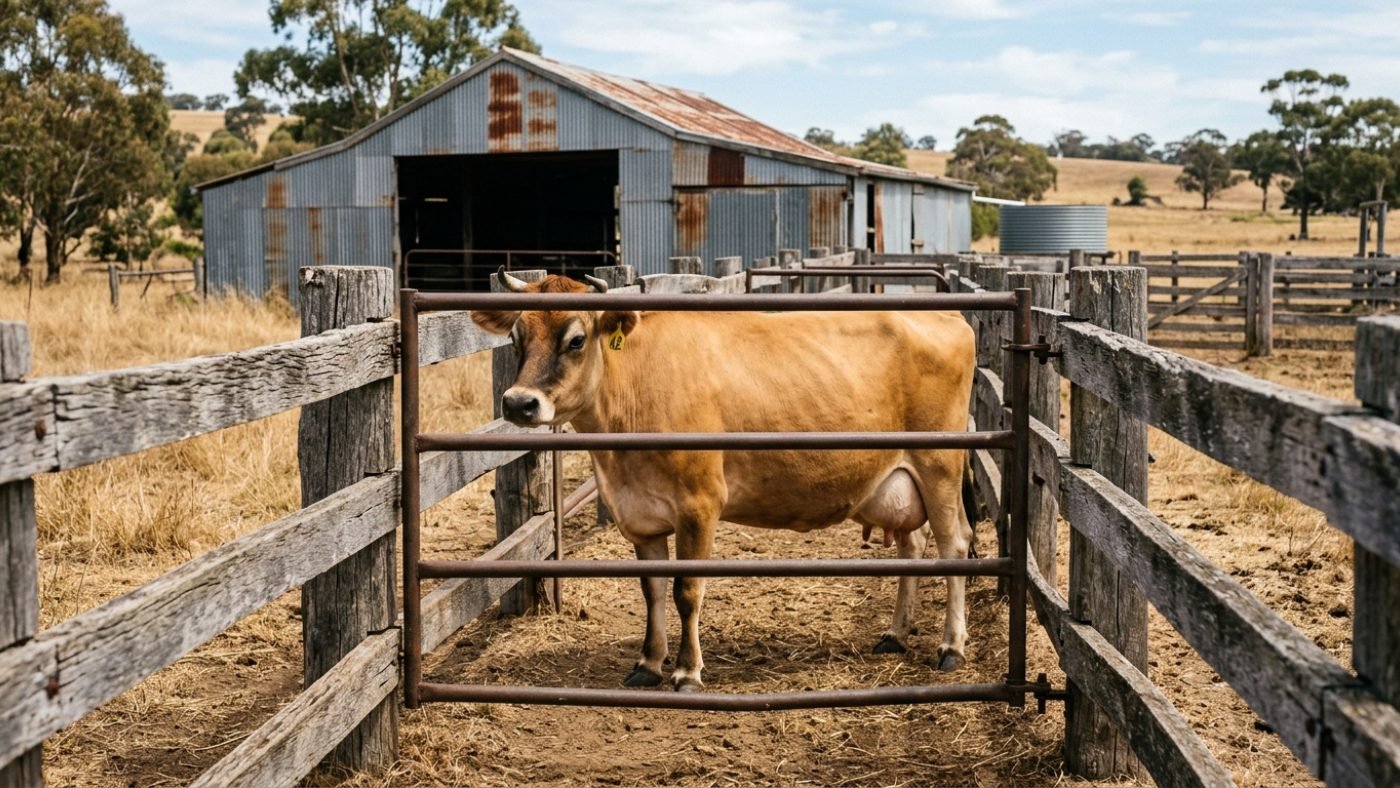
Most bad cattle purchases are decided in the first ten minutes, by someone who has driven two hours, feels rude leaving empty-handed, and talks themselves into an animal they already had doubts about. The single most useful thing in this article is permission to walk away.
Everything below is what to look at, in the order you should look at it.
Before you go: know what you're buying for
A house cow, a breeder, a steer to fatten and a show calf are four different animals. Decide first, because the compromises differ. And work out your land honestly — NSW DPIRD's 2026 budgets carry a cow unit on about 1.7 hectares of good coastal improved pasture and 3.7 hectares inland. Buying more animals than your country carries is the most common beginner error, and it shows up as a feed bill in February.
Temperament first, always
This is the one that ruins lives, and the one most beginners check last.
Watch the animal before anyone catches it. Does it move away calmly or explode? Can the owner walk up to it in the paddock? Ask directly: "has this cow been handled? Has she been in a crush? Has anyone milked her?" Then ask them to demonstrate. An owner who suddenly has reasons why that's not convenient today has told you the answer.
Pay more for quiet. A halter-broken, handled animal might cost noticeably more than an unhandled one of identical breeding. It is the best money you will spend. A wild cow on a small block is dangerous, can't be treated when sick, and will teach every other animal you own to be difficult.
The physical check
Walk around the animal properly. From a distance first, then close.
Feet and legs. Watch it walk. Any limp, any reluctance to bear weight, any overgrown or misshapen hoof is a serious mark against. Lameness is expensive, recurring and often permanent.
Udder (for any female you'll milk or breed from). Four working quarters, evenly sized, no hard lumps, no heat, no swelling. Teats should be a size you can actually get a hand around. A quarter lost to previous mastitis never comes back — check by feeling each one.
Eyes. Clear and bright. Cloudiness, weeping or a growth on the eye or eyelid — particularly in white-faced breeds — is a reason to walk away.
Body condition. You want the animal in fair working condition. Very thin raises questions about health, worms or age. Unusually fat can mask problems and, in a breeder, cause calving trouble.
Coat and general demeanour. A dull, staring coat, a drooping head, or an animal standing apart from the mob all warrant questions.
Teeth tell you age approximately, and any seller should be willing to let you look.
Ask these questions, and expect real answers
- Why are you selling? The answer, and how readily it comes, is informative.
- What's her vaccination history? Specifically: has she had 7-in-1, and how many doses? Remember an unvaccinated animal needs two doses four to six weeks apart before annual boosters mean anything.
- Has she calved before? How many times? Any trouble?
- Is she pregnant, and is that confirmed by a vet? "We think so" is not a yes. Pregnancy testing exists.
- Any history of mastitis, milk fever or lameness?
- What's she been eating? An animal moving from grain to bare pasture, or vice versa, needs a careful transition.
The paperwork — don't skip this
This is where hobby buyers most often end up accidentally non-compliant.
- The animal must carry an NLIS device before it moves off the property.
- You need a Property Identification Code (PIC) for your own land before livestock arrive. Note this isn't necessarily free or permanent — in NSW it's typically renewed every three years and may attract a fee.
- You'll receive a vendor declaration or waybill. Keep it for at least two years.
- As the buyer, you must record the movement on the NLIS database — within 48 hours in most states. This is your legal obligation, not the seller's.
Saleyard or private sale?
A private sale from a known breeder is almost always better for a first animal. You can see how it's been kept, meet its mother, ask questions, and often get ongoing advice. You'll pay more.
Saleyards are cheaper and faster, but you're buying at a distance, under time pressure, from a pen of stressed animals, with no history and no comeback. Experienced buyers do well there. First-timers frequently don't. If you do go, go once with no money simply to watch.
What to expect on price
Commercial cattle trade in cents per kilogram of liveweight, and 2026 has been an expensive year — Elders had restocker steers at 470–569 c/kg in early July 2026, with NSW DPIRD costing a 260 kg steer weaner at about $1,409.
Quiet house cows, though, trade privately through local listings and breed societies, and no market report covers them. Watch listings in your district for a month before you buy so you know what normal looks like. Anyone quoting you a firm price without seeing the animal is guessing.
The rule that saves people
Take someone experienced with you. A neighbour, a local farmer, anyone who has bought cattle before. They will notice in thirty seconds what you'd miss entirely, and they'll be far more willing than you are to say "no, let's go."
Next: how to halter train a calf, and our beginner's guide to keeping a house cow.
General information only, not veterinary advice. Have a vet check any animal you're serious about, and confirm legal requirements with your state department of agriculture or primary industries.