
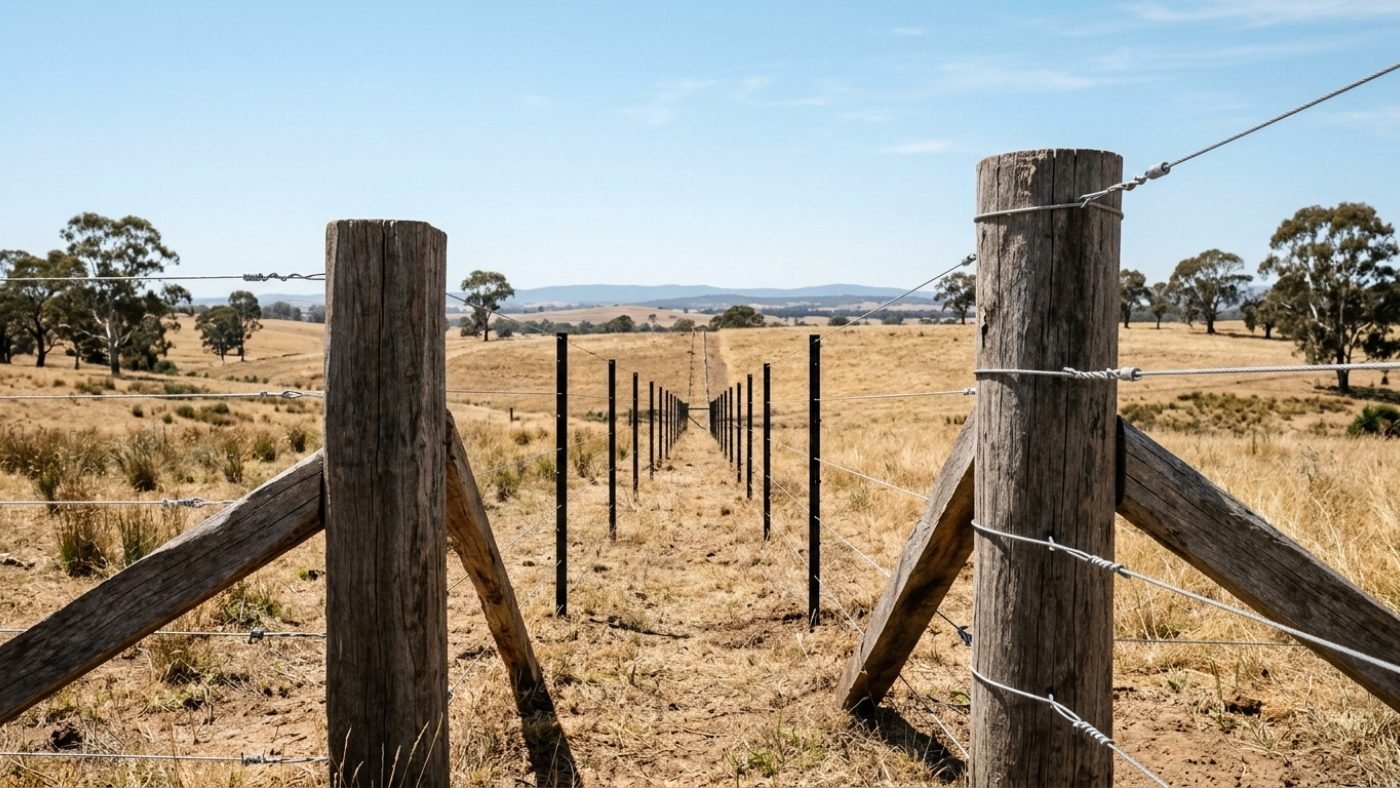
Fencing is the largest single thing most small blocks spend money on, and the one where a bad decision is hardest to reverse. A fence in the wrong place doesn't just cost what it cost — it locks in where your water is, where your laneways run, and how much walking you do for the next thirty years.
Here is what the materials actually cost in 2026, what the standard spacings are, what the law says about your boundary, and the mistakes that are worth someone else's money to learn.
Choosing the fence for cattle
Cattle are heavy and push rather than jump or crawl. That single fact drives the design. Where sheep need a barrier close to the ground and horses need something they can see, cattle need something that holds when half a tonne leans on it — which means the strength lives in the strainer assemblies and the tension, not in the mesh.
The practical options:
- Plain high-tensile wire, four or five strands, with good strainers. The cheapest permanent option per metre and the most common cattle boundary in Australia.
- Plain wire with a barb on top. Barbed wire works on animals with a hide, which is why it is standard for cattle and wrong for horses. Think twice where people work close to the fence.
- Hinge-joint or ringlock with a plain or barbed top wire — the mixed-stock fence, if you might ever run sheep. Waratah's published cattle design uses 8/90/30 hinge joint plus 1.80 mm high-tensile barbed wire on star posts at a 3:1 ratio, three steel posts to every strainer-grade post.
- Electric, permanent or temporary. Cheap per metre, excellent for subdivision, and the fastest way to make a small block behave like a bigger one. An offset hot wire on the inside of an existing fence also takes the pressure off it.
Spacings and specifications
For cattle, star pickets go at 4 m centres on flat ground and 3 m on hilly country. Posts should be at least 600 mm in the ground. Strainers belong at corners, gateways and topography changes, plus inline roughly every 100 m on long flat runs — and in hills, at the bottom of every gully and the top of every hill.
Strainer posts should be 80NB (89 mm outside diameter) or 100NB (114 mm). Depth matters more than most people expect: a strainer set one metre deep has about double the holding capacity of one set at 750 mm. Driving beats setting in concrete. Diagonal stays should meet the post three-quarters of the way up from ground level and be at least two and a half times the fence height — so for a 1.2 m fence, a stay of 3 m or more.
For gates, the rule is to measure your widest piece of machinery and add a metre to a metre and a half of clearance each side. Retail guidance puts 3.0–3.6 m as the standard stock-and-vehicle gate and 4.2–6.0 m for machinery. And if you are planning laneways, Agriculture Victoria suggests 20–25 m wide works well for most cattle and sheep properties.
What the materials cost
All prices below were checked on 26 July 2026 from Australian online suppliers. Note that Bunnings and several rural chains block automated price checking, and Elders and Nutrien quote through branches rather than publishing retail prices — so these are real current prices, but not national benchmarks. Ring your local store before you budget.
| Item | Price | Unit |
|---|---|---|
| Star picket, bituminised, 1.65 m | $7.50–$8.00 | each |
| Star picket, bituminised, 1.80 m | $8.50 | each |
| Star picket, bituminised, 2.10 m | $10.00 | each |
| Waratah JIO star post, 180 cm | $14.70 | each |
| Treated pine post, 2.4 m, 150–175 mm, H4 | $35.00 | each |
| High-tensile plain wire, 2.5 mm × 1500 m | $101.00 | per roll (6.7c/m) |
| Barbed wire, 1.8 mm HT, 500 m | $125.00 | per roll (25c/m) |
| Hinge joint 8/90/30, 200 m | $335.00 | per roll ($1.68/m) |
| Poly wire, 2.5 mm × 500 m | $62.85 | per roll (12.6c/m) |
| Pinlock insulators for steel posts | $37.40 | 25-pack ($1.50 each) |
| Galvanised farm gate, 2.4 m | $77.00 | each |
| Farm gate, 4 ft to 16 ft range | $85–$225 | each |
The arithmetic that surprises people: the wire is almost free. At 6.7 cents a metre, five strands of plain high-tensile wire costs about $335 a kilometre. It is the posts, the strainers and the labour that make up the bill.
What it costs installed
The most credible Australian per-kilometre figure we found comes from NSW Farmers, who costed traditional post-and-wire fencing on a beef property at $104,020 for 14.9 km — about $6,984 per kilometre, or just under $7 a metre — in a submission to NSW Parliament dated 25 July 2024.
Trade quoting sites give higher per-metre ranges because they are pricing different fences. Airtasker's May 2025 guide puts simple stock fencing with wire mesh and posts at 3 m spacing at $18–$20 per metre on flat ground with machinery access, with plain wire at $5–$8/m, paddock fencing $10–$25/m and electric $50–$120/m. These are job prices for shorter runs, not paddock fencing at scale. Both sets of numbers are right; they describe different specifications.
On DIY versus contractor, we could not find any published Australian source quantifying the saving, and would rather say so than invent a percentage. What you can do is arithmetic: at roughly $7,000 a kilometre all-in against materials of very roughly $2,500–$4,500 a kilometre for a four or five wire cattle fence, labour is broadly the balance — and it is hard, skilled work that will take you far longer than it takes a contractor.
Electric fencing, properly
The number that matters on an energiser is joules, not volts. Almost every energiser puts out around 7,500 volts; the stored joules determine how much fence and how much vegetation it can drive through. For cattle, a rating of roughly 0.5 to 5 joules covers most situations, with more needed for long lines or heavy growth.
Current Gallagher Australia pricing, checked 26 July 2026: the mains M50 (0.5 J, 4 km) is $226.69, the M160 (1.6 J, 4 km) $313.26 and the M650 (6.5 J, 10 km) $792.40. Solar units cost considerably more for the same output — the S120 (1.2 J, 4 km) is $805.06 and the S200 (2 J, 5 km) $1,050.04. Those kilometre ratings are manufacturer figures under ideal conditions.
Earthing is where electric fences fail. Gallagher puts it at 80% of all power fence problems. The specification is unambiguous: galvanised earth stakes, minimum 2 m long, spaced 4 m apart, joined with high-conductive cable, and kept at least 10 m away from any other electrical earth or metal water pipe. Never copper, never rebar. Three stakes for an energiser up to 15 J, five up to 25 J, seven up to 35 J.
To test it, short the fence until it reads 2,000 volts or less, then measure the earth system. Up to 200 volts is acceptable. More than that means you need more stakes.
Trained cattle are easy to hold — Gallagher notes that a single hot cross-wire will contain dairy or trained cattle. Untrained ones need to meet the fence once, properly, in a small pen where the shock is a surprise rather than a panic. Tie something visible to the wire; cattle learn faster when they can see what bit them.
The boundary fence and the law
Every state has a dividing fences act, and they all start from the same principle — adjoining owners contribute equally to a fence sufficient for the land — but the notice periods and the tribunals differ enough to matter.
| State | Act | Time to respond | Where disputes go |
|---|---|---|---|
| NSW | Dividing Fences Act 1991 | 1 month | Local Court or NCAT |
| VIC | Fences Act 1968 | 30 days | Dispute Settlement Centre, then Magistrates' Court |
| QLD | Neighbourhood Disputes Act 2011 | 1 month | QCAT |
| SA | Fences Act 1975 | 30 days | Magistrates Court |
| WA | Dividing Fences Act 1961 | 14 days (repairs) / 21 days to apply to court | Magistrates Court |
| TAS | Boundary Fences Act 1908 | 21 days notice, 21 days to object | Binding arbitration |
Two useful details. First, if you want a better fence than "sufficient", you pay the difference — that is consistent across the states. Second, rural land is treated differently from suburban land: Queensland's act defines a sufficient dividing fence between pastoral parcels as simply one "sufficient to restrain livestock of the type grazing on each" parcel, with no prescribed height or material, and Western Australia and Tasmania both use the old formulation of a substantial fence capable of resisting cattle and sheep.
One warning specific to Queensland: sources disagree on whether the dividing fence provisions apply at all where both parcels are agricultural land. QCAT and the Queensland Law Handbook describe the exclusion differently. If you are in Queensland and a boundary fence is about to become a dispute, get advice on section 20 of the Act rather than relying on a summary — including this one.
The mistakes
Under-building the strainers. Corners, ends and strainer assemblies carry the tension of the entire fence. Everything downstream of a weak one goes gradually out of line, and you cannot fix it by tightening the wire.
Fencing before you have decided where the water goes. This is the expensive one. A new fence that leaves a trough on the wrong side creates a management problem you will live with daily. Walk the block first — drainage, existing tracks, fall, tree clearance — and plan water points and laneways before a single post goes in.
Gates too narrow, too light, or in the wrong place. Gates near corners put stress on the assemblies that hold the fence up. Gates sized for the ute rather than the contractor's tractor become a permanent tax on your time. And the stock truck has to be able to reach the yards — think about that before you fence the approach.
Getting the tension wrong. Over-tensioning breaks wire and pulls strainers; under-tensioning gives you a fence that sags into uselessness in three summers. Published Australian tension figures are surprisingly hard to find — the numbers we located come from a 2012/13 Waratah catalogue, which we would not print as current advice. Use a tension indicator and follow the manufacturer's figure for the wire you have bought.
If you only do one thing
Fence the boundary properly and subdivide with electric. A permanent boundary you will never move deserves good strainers and real posts. The internal fences that determine how you graze are the ones you will want to change once you have run the place for a year — and a poly wire and a reel cost less than a hundred dollars to be wrong with.