
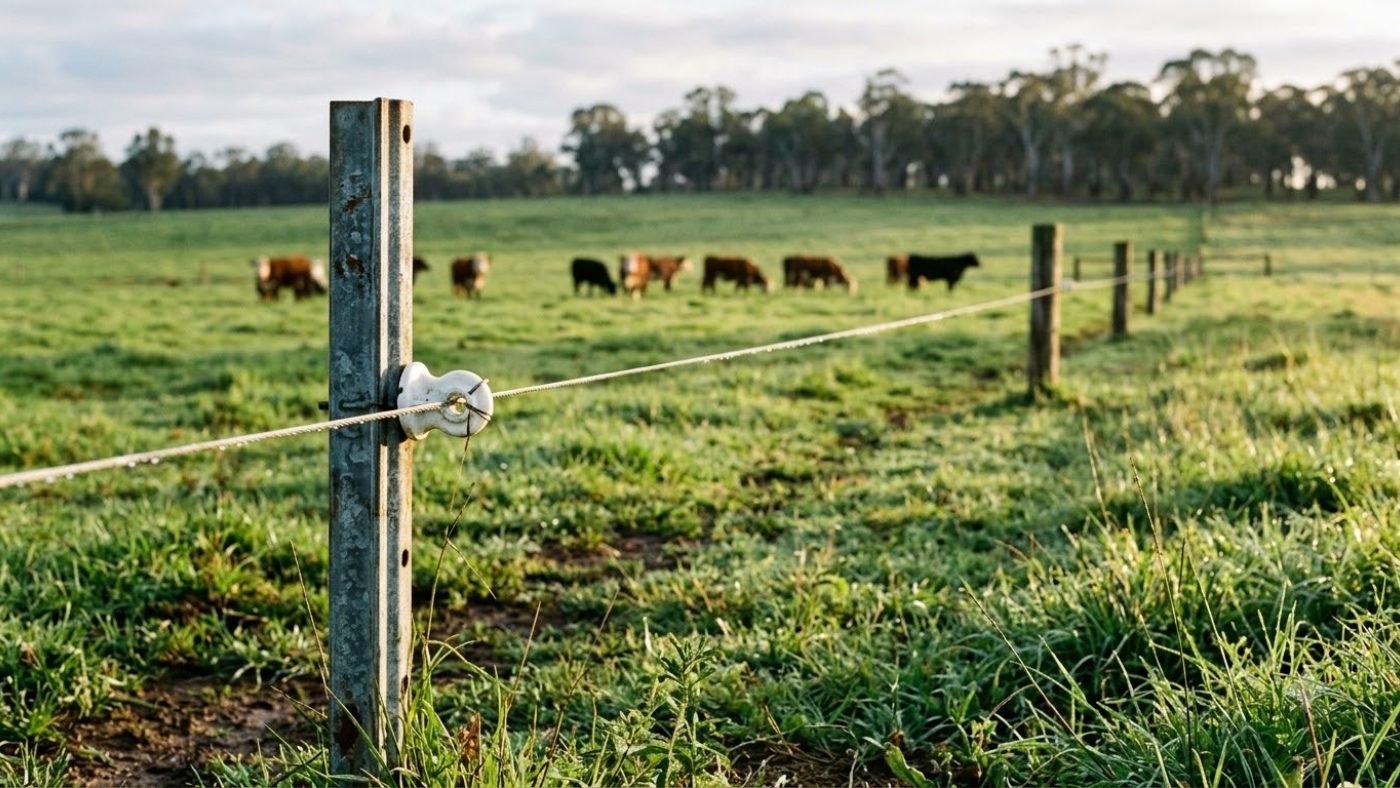
An electric fence is a psychological barrier, not a physical one. It works because a beast touches it once, remembers, and never tests it again. Everything about choosing an energiser comes back to that: the shock has to be memorable the first time, on the worst day of the year, at the far corner of the property.
Which is why undersizing is the expensive mistake. A fence that stings in winter and tickles in a dry February teaches cattle that the wire is negotiable, and once they know that you have lost the fence.
Joules: stored, output, and the number that means nothing
Energisers are sold on joules, and there are two kinds.
Stored joules is the energy sitting in the capacitor before it discharges. Output joules is what actually goes down the wire, and it is only meaningful if the load resistance is stated alongside it. The Australian manufacturer Pakton puts it well: stored joules is engine capacity in cubic centimetres, output joules is brake horsepower. A small capacitor charged very high can post an impressive stored figure and still perform poorly.
Gallagher Australia publishes both, and the gap between them varies enormously across their own range: the M160 stores 1.6 J and outputs 0.86, while the MBS100 stores 1.0 and outputs 0.97. That is 54 per cent efficiency against 97 per cent. Comparing two energisers on stored joules alone tells you very little.
Worse, output figures are often quoted at different loads. Thunderbird quotes one model at 0.24 J into 1,000 ohms, another at 0.58 J into 250 ohms, another at 3.8 J into 200 ohms. Those three numbers cannot be compared with each other. The safety standard measures at 500 ohms, which is the only common reference point going.
Kilometre ratings are marketing
Every energiser is advertised with a distance. Treat them as sales copy, and you do not have to take my word for it — JVA's own product page says the kilometre figure “depends on your farm electric fence conditions and therefore varies greatly,” and that the best way to compare energisers is pulse output energy in joules. Pakton calls km ratings “best case.”
How wide is the gap? JVA rates a 3.0 J output unit at 30 km. Gallagher rates a 6.5 J stored unit at 10 km recommended. Same market, roughly six times the claimed reach per joule. Neither is lying — Gallagher quotes what works with vegetation on the line, JVA quotes ideal conditions on clean wire.
Sizing: the mistake almost everyone makes
Here is the one that catches people. Energiser ratings are given in wire length, not fence length.
A ten-hectare square block has a perimeter of about 1,265 metres. Run three live wires and you have 3.8 km of wire — three times the fence length, and that is before any internal subdivision. Size against the perimeter and you will buy an energiser a third of the size you need.
Gallagher Australia's published table, which is the clearest treatment I found:
- M50 — 0.5 J stored, 4 km multiwire, 2 ha
- MBS100 — 1.0 J, 3 km recommended (10 km ideal), 4 ha
- M160 — 1.6 J, 4 km recommended (14 km ideal), 6 ha
- S200 (solar) — 2.0 J, 5 km, 8 ha
- M650 — 6.5 J, 10 km, 26 ha
- M1400 — 14 J, 14 km, 22 ha
Note the last two: a 6.5 J unit is rated for more hectares than a 14 J unit. Gallagher's own table is internally inconsistent, which is a decent argument for treating hectare ratings as indicative and sizing on wire length instead.
What size for a small block
On the published figures, a genuinely small place of two to twenty hectares is covered by 1 to 2 stored joules. The M160 at 1.6 J is rated to six hectares; the solar S200 at 2 J to eight.
That said, on mains power the step up to 4 to 6 joules costs surprisingly little and buys you two things worth having: headroom for vegetation growing onto the line in spring, and room to subdivide later without replacing the unit. If you are buying once, buy the bigger one.
Voltage: what cattle actually need
Different animals need different voltages, mostly because of coat thickness. Speedrite's published chart gives beef cattle 2,000–3,000 V (bulls at the higher end), dairy cattle 2,000, and sheep and goats 4,000–5,000 V — wool is a very good insulator.
Pakton reckons effective fencing generally needs above about 3.5 kV, and Gallagher treats a reading below 3 kV as a sign of poor animal control. So the sources genuinely conflict: 2 kV at the low end, 3.5 at the high.
A defensible target for cattle is 3 to 4 kV measured at the far end of the fence, not at the energiser. Everything degrades with distance, vegetation and damp; measuring where it is strongest tells you nothing useful.
Earthing: the part that gets botched
If your fence works in winter and fails in summer, the earth is almost certainly the problem. The circuit runs through the animal and back through the soil, so dry soil means a weak shock no matter how big the energiser.
Gallagher's 4-3-2-1 rule: at least 3 stakes, minimum 2 metres long, 4 metres apart, joined by 1 wire back to the energiser earth terminal. More stakes for bigger units — stored joules divided by five, minimum three.
Thunderbird is more relaxed: stakes driven 1.5 m, one stake below 1.5 J, two below 4 J, three above. Sureguard says at least 1.5 m deep, 3 to 15 m apart.
They conflict. Gallagher's is the safer default — three stakes minimum regardless of size, because the cost of two extra stakes is trivial against a fence that fails in February.
Three points everyone agrees on, and they matter:
- Galvanised only. Not copper, not reinforcing bar — mixing metals corrodes the connection.
- At least 10 metres from any other electrical earth, and from metal water pipes. This one comes from the standard, not from a manufacturer's preference.
- Re-earth negative wires periodically along long runs.
One practical snag: Gallagher specifies 2 m stakes, but Australian retail earth stakes are commonly sold at 0.9 to 1 m. You may need to buy more of them, or drive lengths of galvanised pipe.
Testing the earth
The test is simple. Short the fence out deliberately at least 100 m from the energiser until the fence voltage drops to around 2 kV, then measure between your earth system and an independent probe about a metre away. That reading is what is leaking.
The acceptable figure depends who you ask: Gallagher says 200 V or less, ideally zero; Thunderbird says under 400; Sureguard tolerates up to 500. Use 200 V if you want a fence that still works in a dry summer.
Mains, battery or solar
Mains is dramatically cheaper per joule. Gallagher's M160 at 1.6 J is $313; the solar S200 at 2 J is $1,050 — more than three times the price for a marginal gain in output. Running cost is negligible either way; the M160 draws about 1.5 watts.
The critical safety point: mains energisers and their plug packs must not be installed outdoors. Mount the unit inside a shed and run insulated lead-out cable to the fence. If there is a shed with power anywhere near your fence line, mains plus a long lead-out is almost always the right answer.
Solar earns its price when there is genuinely no supply. Multi-powered units that run on mains or 12 volt let you start one way and change your mind later.
The rules
Electric fences in Australia are governed by AS/NZS 3014 (electric fences) and AS/NZS 60335.2.76 (the energiser itself). Note that AS/NZS 3014 dates from 2003 and is currently under revision. Both are paywalled, and everything below is drawn from manufacturer and retailer summaries rather than the clause text — if you are installing near a road or a boundary, buying the standard is worth the hundred-odd dollars.
The published rules that come up most:
- One energiser per fence. A fence must not be fed from two separate energisers.
- Two independently energised fences must be at least 2.5 m apart.
- Barbed and razor wire must never be electrified. A non-electrified barb fence may carry an offset live wire at least 150 mm clear.
- Overhead power line clearances: 3 m under 1 kV, 4 m for 1–33 kV, 8 m above that.
- Where a fence crosses public access, provide a non-electrified gate or stile, and sign every gateway.
- Switch off or reduce output during fire danger periods, and disconnect in thunderstorms without a lightning diverter.
Warning signs are worth checking rather than guessing. Two Australian suppliers publish different specifications — one says 100 × 200 mm, yellow background both sides, black lettering at least 25 mm high; another says red on white, 13 mm letters, 62 × 50 mm, at intervals not exceeding 90 m. The yellow-and-black specification appears to be what the current standard requires, but confirm it against the standard itself before you order signs.
On boundary fences shared with a neighbour, I could not find an authoritative answer and will not invent one. Some councils reportedly discourage or restrict electric fences between private properties, and dividing-fence legislation differs in every state. Check your council and your state's fencing act before energising a boundary.
When it stops working
The diagnostic sequence that saves the most walking:
- Measure at the energiser terminals with the fence disconnected. That separates an energiser fault from a fence fault immediately.
- Measure between the earth terminal and true ground. Over 400 V and your earth is the problem.
- Sectionalise with cut-out switches to bracket which run is at fault.
- Tune an AM radio to a weak station and walk the line — the loudest interference marks the arcing join or cracked insulator.
The usual culprits, in order: vegetation growing onto the line (the biggest continuous load, worst when wet), oxidised twisted joins that should have been proper crimps, cracked or tracking insulators, and an undersized earth. A fault finder that shows the direction of the fault turns an afternoon into ten minutes; Gallagher's is about $330.
One limit worth knowing: standard polywire and tape is rated to only about 400 m from the energiser. For permanent runs use 2.5 or 3 mm galvanised wire.
What it costs
Australian prices as listed in August 2026. Gallagher energisers: M50 $226.69, M160 $313.26, MBS100 $400.20, M650 $792.40, M1400 $1,354.66. Solar: S20 $479.46, S200 $1,050.04. A JVA MB3 at 3 J output, mains or battery, is $316.35 including GST.
The bits around it: galvanised earth stakes run $10 to $20 each depending on brand and length, an earth clamp about $13, and pinlock insulators around $21 for a bag of 25.
A realistic hardware total for a small mains setup — M160, three earth stakes, clamp, and about a hundred insulators — comes to roughly $465, or $795 with a fault finder. That excludes wire, posts, lead-out cable, gate handles and cut-out switches. Going solar instead adds about $740.
Set against a plain wire fence at several thousand dollars a kilometre, an electric offset wire is the cheapest cattle control money buys — provided the earth is right.
If you are still working out the fence itself rather than the power going through it, what fencing materials cost and the mistakes worth avoiding covers the rest.