
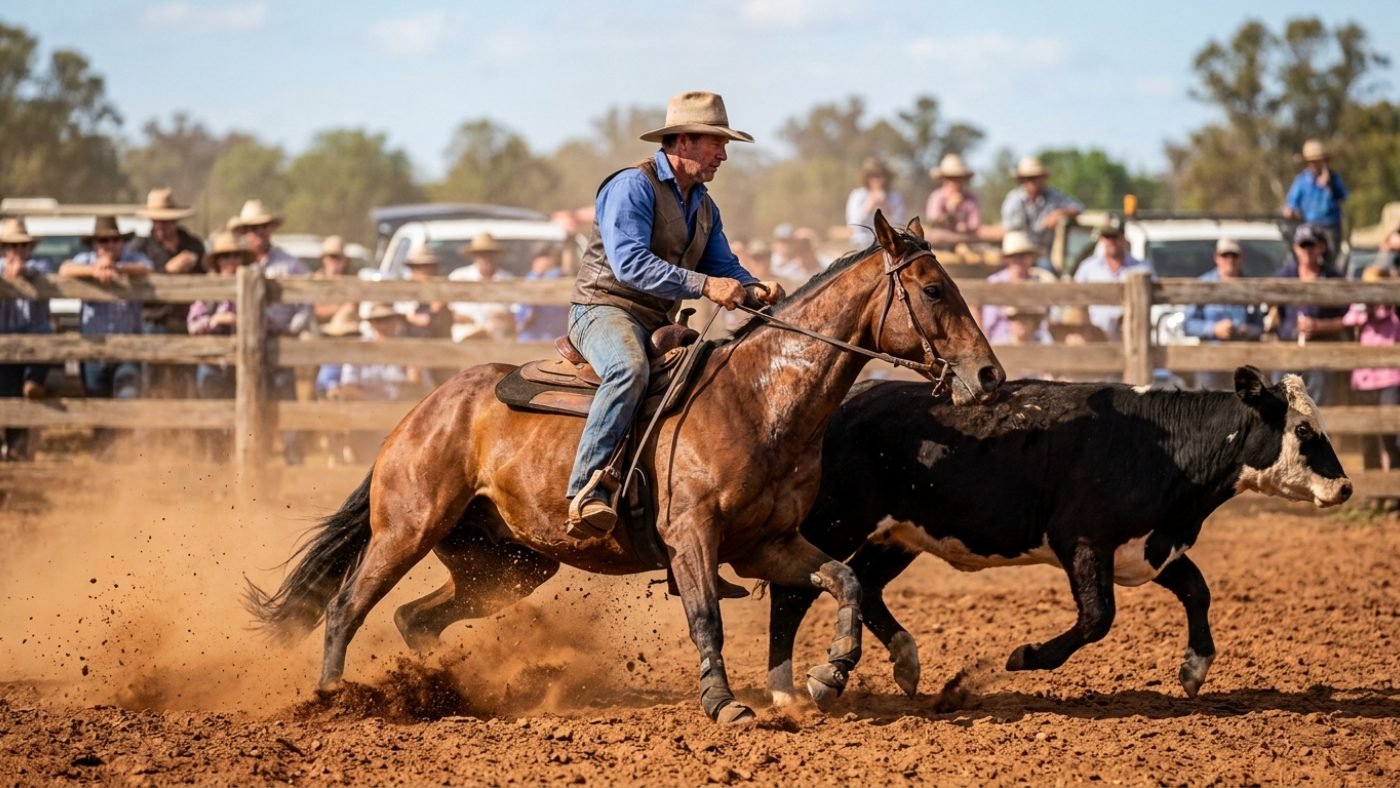
Watch a campdraft run for the first time and you will probably think the rider isn't doing much. A horse and a beast move around an arena, there is some dust, a whistle blows, someone reads out a number in the eighties.
What you are actually watching is a horse reading an animal's mind. Seventy of the hundred points on offer are for that alone. Here is how to see it.
Where it came from
The sport grew out of informal contests between stockmen in the 1880s, and the honest answer about its exact origin is that nobody is certain — the industry's own magazine says so plainly.
The widely accepted account is that the first recognised competition was held at the Tenterfield Show in New South Wales in 1885, on vacant land outside the main ring. Clarence W. Smith of Boorook Station, east of Tenterfield, is credited with drawing up the rules; he drove his cattle roughly four days into town for it. Cattle were supplied by W.A. Walker of Tenterfield Station. The winner was John Hynes.
Sources part company on the details. Some accounts say Smith wrote the rules for that first event; others say he competed in it and codified the sport afterwards. Some place the roots in outback Queensland rather than New England. Even the Tenterfield Show Society hedges, describing 1885 as "believed to be" the first campdraft staged in the nation.
What is certain is that Tenterfield still runs the C.W. Smith Memorial Open and marked the 140th anniversary with a plaque in May 2025.
The rules were not fixed at the start. Originally there was no course at all, and a rider could turn the beast however they liked. A judge named Bob Campbell later cut the time limit from 60 seconds to 45, and a formal course was introduced to make judging consistent. Today it is 40 seconds.
One to watch out for. There is a well-known Australian named Clarence Herbert Smith who invented the stump-jump plough in 1876. Different man, different state, nothing to do with campdrafting. The campdraft figure is Clarence W. Smith.
How a run works
There are two arenas back to back: a small yard called the camp, and a big open course.
1. The camp
A mob of cattle — a minimum of six head, usually six to eight — is held in a small yard. The rider walks in quietly. The clock is not running.
2. Choosing a beast
The rider picks one animal out. This is not casual: they are looking for one that will run straight and honestly. Taking too long over it is itself a disqualification.
3. Cutting out
The rider works that beast away from the others and holds it clear at the front of the camp, using the horse's body to keep the mob behind and the chosen beast in front. Worth up to 26 points.
4. The block and turn
This is the part spectators most often miss the meaning of. The beast wants to get back to its mates. Every time it breaks one way, the horse has to move across, block it and force it to turn back. The rider must show this cleanly two or three times.
A good campdraft horse anticipates — it moves before the rider asks, because it has read where the beast is going. That is what the judge is marking. If the beast gets back into the mob twice, the run is over.
5. Calling for the gate
Satisfied, the rider calls for the gate and the gatemen swing it open into the big arena. Critically, only one beast may come out. Calling with more than one in front of the horse, and then letting more than one through, is a disqualification.
6. The clock starts
Timing begins the instant the horse leaves the cut-out — not when the rider entered the camp. Forty seconds.
7. The pegs and the figure eight
Two pegs stand well apart in the arena. The rider must drive the beast in a full circle around the first peg, then swing it back the other way in a full circle around the second — one turn left, one turn right, tracing a figure eight across the ground. The horse does the steering the whole way: pushing the beast onto line, holding it off the fence, keeping it moving.
First peg, 2 points. Second peg, 1 point. Knocking the first peg down — by horse, rider or beast — ends the run immediately.
8. The gate
At the far end, two more pegs form a gate. Drive the beast cleanly through the gap. That is the final 1 point and it completes the course.
9. The score
A whistle or a stockwhip crack ends it.
The scoring, precisely
| Component | Maximum | What it is |
|---|---|---|
| Horse work | 70 | The judge's subjective mark for how the horse worked |
| Cut out | 26 | Selecting and controlling the beast in the camp |
| Course | 4 | 2 for the first peg, 1 for the second, 1 for the gate |
| Total | 100 |
Those four course points are completion marks — you get them for getting the beast around each marker, not for style. Everything subjective lives in the 96.
A perfect 100 is effectively unheard of. A winning open run scores in the high 80s to low 90s: Pete Comiskey scored 90 in the 2026 Gold Buckle final; William Tapp put together 91, 90 and 90 at Chinchilla in October 2025.
What kills a run
In the camp: losing the beast back into the mob twice, or losing control of it a second time at the judge's discretion; unnecessary delay picking one; changing your beast after getting clear of the cattle; calling for the gate with more than one beast in front and taking more than one out.
On the course: knocking the first peg down; losing control in the arena; running the beast into the fence; taking it past the gate on the wrong side or before finishing the pegs.
Anywhere: a tail turn — letting the horse's hindquarters swing toward the beast instead of facing it; causing hock injuries; a fall that costs control; ill-treating horse or beast; refusing sound stock; being absent on the third call.
One thing that does not end a run: running out of time. If the clock lapses while you still have control, you are still scored — you simply forfeit the peg and gate points you hadn't earned yet.
A note on the time limit. The Australian Campdraft Association, Southern Campdraft Association and Campdraft Central rule books all state 40 seconds. The ABCRA's public explainer page says "usually 45 to 47 seconds." We could not find a campdraft time limit in ABCRA's own rule book to settle it, so treat 40 seconds as standard and expect some variation between associations and events.
Who runs it
The Australian Campdraft Association was formed in 1972, with Ashley McKay as its first president and his wife Doris as secretary for a decade. It moved its office from Roma to Toowoomba in 2023. It is a not-for-profit and every host committee runs on volunteers.
The ACA describes campdrafting as the fastest growing equine sport in Australia, with more than 15,000 competitors. In 2024 it affiliated 170 campdrafts from Western Australia to far north Queensland, ran 15 educational clinics, added 44 judges to a panel of over 800, and presented more than 600 awards.
It is one of four bodies under the National Campdraft Council of Australia, alongside the Australian Bushmen's Campdraft and Rodeo Association — which dates to 1946 and claims over 7,000 members — the Southern Campdrafters and the Gippsland Campdraft Association.
Where to watch one
The Warwick Gold Cup, Warwick, Queensland, is the one to see. Called the Melbourne Cup of campdrafting, it runs alongside the Warwick Rodeo — which began in 1906 as a Bushman's Carnival — over the last weekend in October. The 2025 event drew more than 30,000 spectators, got through 2,482 runs, and was supported by 1,450-plus head of donated Wagyu and over 350 volunteers. Rohan Marks won it on Turnermarks Linesman, a nine-year-old homebred stallion out of the 2019 winner.
The Gold Cup campdraft alone paid $137,900 in 2025, with $35,000 to the winner. For 2026 the final moves from Sunday to Saturday afternoon.
The Willinga Park Gold Buckle at Bawley Point, New South Wales, is the richest — over $500,000 in cash and prizes in 2026, with $100,000 to the Grand Champion. The 2026 event ran 8 to 11 July and drew almost 1,000 nominations from more than 240 competitors, needing around 2,000 head of cattle to support 1,200-plus runs. Since 2018 it has paid out over $2.5 million and generated an estimated $7 million for the Shoalhaven.
Pete Comiskey of Nebo won it in 2026 on Soda Blue Exotic with an aggregate of 179.5, beating Mark Buttsworth by half a point. It was his fourth Gold Buckle.
The Chinchilla Grandfather Clock in Queensland drew a record 640 starters in 2025, won by William Tapp on his homebred mare Lonesome Dove Flight. Together with the Condamine Bell and Warwick it forms the Queensland Triple Crown.
One to note: the 2026 Paradise Lagoons Campdraft near Rockhampton was postponed, citing fuel cost and availability. The next running is billed as the 25th annual, in April 2027. Spectator entry is a gold-coin donation to the Royal Flying Doctor Service.
The horses
The Australian Stock Horse dominates, and the relationship runs deeper than preference — the Australian Stock Horse Society was founded by campdrafters, when over a hundred of them met at Scone in June 1971. It now has about 8,500 members and records for more than 200,000 horses.
The ideal is around 15 hands: agile and fast, with enough body weight to hold a beast, able to turn tight while staying responsive — and, above all, with cattle sense.
Good ones are not cheap. At the 2025 Nutrien Classic at Tamworth, 492 lots sold for a gross of $13.58 million at an average of $27,499, up 10% on the year before, with 92.7% clearance. Geldings averaged $20,777 and mares $33,909. Top price was $180,000 for the mare A Sandie Blonde. The Dalby Australian Stock Horse Sale averaged $27,170 and made a record $170,000 for a nine-year-old mare.
At Charters Towers in May 2026 the average was $17,683 with a top of $50,000. So: roughly $18,000 to $27,500 for a competitive ridden horse, $50,000-plus for a good one, and $170,000 to $180,000 at the very top.
Safety
Required gear is a hat or safety helmet, boots, a collared buttoned long-sleeved shirt and long trousers. Note that adults may still wear a hat rather than a helmet; helmets are mandatory only for riders under 18, who must wear one whenever mounted at an affiliated event, complying with Australian and New Zealand standards and fastened under the chin. New FEI helmet standards took effect on 1 January 2026.
There is no published injury-rate research for campdraft riders — no incidence figures, no concussion data. We looked and it does not exist, so we won't invent one.
What does exist is a landmark court decision. In Tapp v Australian Bushmen's Campdraft & Rodeo Association Ltd [2022] HCA 11, decided 6 April 2022, the High Court found the association breached its duty of care. Emily Tapp, an experienced competitor, suffered a serious spinal injury on 8 January 2011 when her horse slipped on a deteriorating arena surface. Several other riders had fallen badly in roughly the preceding 45 minutes and an experienced campdrafter had warned organisers the ground was unsafe. The event continued. The Court rejected the "obvious risk" defence and awarded $6.75 million plus costs, establishing that organisers must stop an event when ground conditions create a substantially elevated risk.
On the horses, a 2025 study in the Equine Veterinary Journal examined 267 campdraft horses and found 53% had forelimb lameness and 41% hindlimb, most commonly graded 2 out of 5, with the distal interphalangeal joint the leading diagnosis at 23%. The authors concluded lameness was more common in the distal forelimb than in comparable cow-horse disciplines.
What to look for
Next time you are at a country show and a campdraft is running, ignore the rider. Watch the horse's ears and its front feet. The good ones are already moving to where the beast is about to go. That anticipation — a stock horse doing on a Saturday what its ancestors did for a living — is the entire sport, and it is worth 70 of the 100 points.