
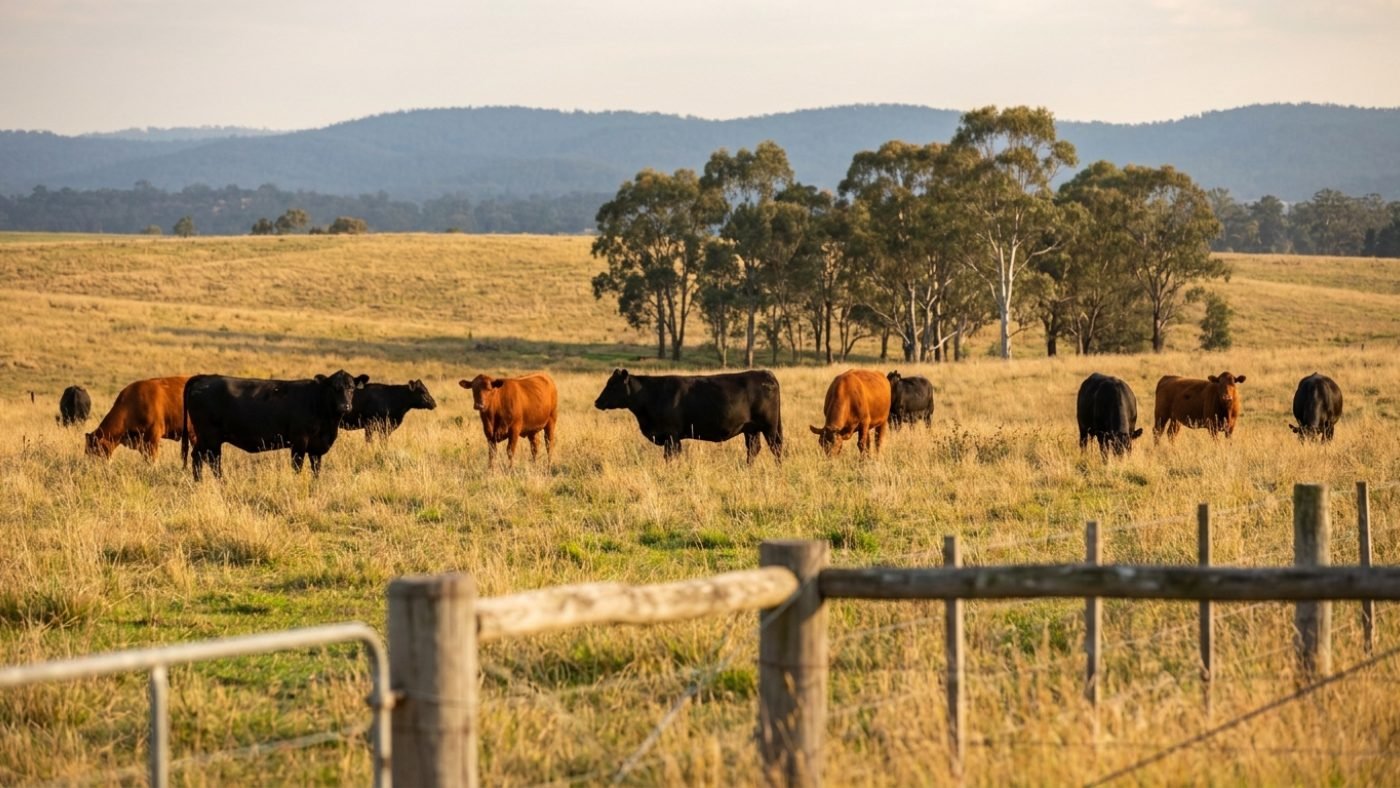
Australia's cattle herd sat at 30.4 million head in June 2024, and Meat & Livestock Australia's projections have it holding above 30 million through 2026. Those animals run on country that ranges from irrigated Tasmanian dairy pasture to Kimberley rangeland where the wet season decides everything.
No single breed copes with all of that, which is why the national herd is such a mix. Drive from Melbourne to Darwin and you'll watch the cattle change with the landscape — black Angus giving way to floppy-eared grey Brahmans as the country gets hotter and the distances between waters get longer.
Here are ten breeds you're most likely to meet over an Australian fence.
1. Angus
The most influential beef breed in southern Australia. Scottish in origin, naturally polled (born hornless), early maturing, and known for well-marbled beef. Mature cows typically run 550–700 kg.
What really cemented Angus, though, was branding. "Angus" became a supermarket and restaurant signal, and that market pull keeps demand for Angus calves strong. Worth knowing as a shopper: AUS-MEAT changed its Angus breed-content rules on 1 July 2026, adding a new "Angus 50" tier for cattle with a minimum 50% Angus parentage, where the previous floor for a breed claim was 75%. Verification rests on the producer's vendor declaration and a visual hide check at slaughter — not DNA.
2. Brahman
Head north and the cattle grow humps and dewlaps. The Brahman was developed in the United States from Indian Bos indicus stock, and it's the backbone of the northern industry. Loose skin and a short, reflective coat shed heat; tick and buffalo-fly resistance is genuinely superior; and they'll walk long distances to water without falling apart.
A large share of the cattle on Queensland, Territory and Kimberley stations carry Brahman blood, and the live export trade is built on them. The trade-off shows up at the meatworks: hump height is one of the traits MSA graders record, because Bos indicus content predicts tougher beef.
3. Hereford
The whiteface. Red bodies, white faces, and a temperament steady enough that generations of Australian kids learned to handle cattle on the family Herefords. They dominated much of the twentieth century here and still hold ground on stations and farms alike.
Their most enduring role now is as a cross. Put a Hereford over an Angus and you get the "black baldy" — black-bodied, white-faced, and carrying the hybrid vigour that makes crossbred females such reliable mothers.
4. Shorthorn
One of Australia's two foundation beef breeds, and the quiet ancestor of half this list. Shorthorns arrived with the First Fleet's successors and spread everywhere; the breed's genetics sit inside the Droughtmaster, the Santa Gertrudis and the Murray Grey.
They're still run commercially in their own right — roan, red or white, docile, good milking ability in the cows, and a strong following in South Australia and the Riverina. If you see a roan cow in a paddock, that's Shorthorn blood showing.
5. Droughtmaster
An Australian invention, and the name is a boast rather than a complaint. From the 1930s Queensland breeders — Monty Atkinson chief among them — joined half-bred Brahman bulls to Shorthorn and Shorthorn–Devon cross females, aiming for an animal that could handle heat, ticks and dry years while still producing quality beef.
The result is red, slick-coated, docile and one of the most popular breeds across northern and central Queensland.
6. Santa Gertrudis
Big, cherry-red, unmistakable. Developed on the King Ranch in Texas from Shorthorn and Brahman blood, and imported to Australia in 1952. Santas handle the same hot country as Brahmans but bring extra size and weight-for-age, and they're widely used as a sire over British-breed cows through central Queensland and the drier parts of New South Wales.
7. Wagyu
The luxury end. Japanese Wagyu genetics produce beef marbled intensely enough to be graded and priced like fine wine, and Australia now runs the largest Wagyu herd outside Japan.
The terminology is worth getting straight. A Fullblood Wagyu has all forebears originating in Japan with no outcrossing, and must be DNA parent-verified to both sire and dam. Purebred means 93% or more Wagyu content, also parent-verified. F1 is a first cross — typically a Wagyu bull over Angus cows — which is what most Australian Wagyu beef actually is.
On the AUS-MEAT marbling scale of 0 to 9+, Australian Fullblood Wagyu regularly scores above 7, where average Australian beef spans about 3 to 7. Graders awarding those top scores need a separate high-marbling endorsement to do it.
8. Holstein-Friesian
The black-and-white cow on every milk carton, and the world's highest-producing dairy breed. Holsteins are the mainstay of Australian dairy country — Gippsland, northern Victoria, the New South Wales coast, Tasmania and south-west WA.
A good Holstein can produce well over thirty litres a day at peak. She is also big and hungry, and only suits a farm that can keep the feed up to her.
9. Jersey
Smaller, fawn-coloured, and giving less volume than a Holstein but richer milk — higher butterfat and protein, which is what cream, butter and cheese are made of. Lighter on soft ground, too, which matters in a wet Gippsland winter.
Jerseys are also the number-one choice for the backyard house cow. If that's where you're headed, read our beginner's guide first — there's a milk fever risk in the breed that's worth knowing about before you buy.
10. Murray Grey
The other home-grown success story, and one whose origin gets mangled constantly. It did not come from a single silver calf. At Thologolong, on the upper Murray in New South Wales, one roan Shorthorn cow put to an Aberdeen Angus bull produced twelve dun-grey calves. Peter and Ena Sutherland bred on from that group, and the Murray Grey came out of it.
They're quiet, easy-calving, and produce tender, well-marbled beef — a favourite with smaller producers who don't want a fight at weaning time.
And the Europeans
One group didn't make the ten but shows up constantly as a terminal sire — the bull whose calves are all destined for market. The Charolais is the best known: big, creamy-white and French, it reached Australia when the first semen was released in March 1969, with the first Australian-born calf in January 1970 and live imports from New Zealand in the early 1970s. Cross a Charolais over British-breed cows and the calves carry serious growth. Limousin and Simmental fill similar roles.
The land picks the breed
That's the pattern underneath Australia's cattle map. Heat, ticks and distance push the north toward Bos indicus blood. Cool country and premium beef branding keep the south British. In between, the crossbreds and the Australian-made composites — Droughtmaster, Murray Grey, Santa Gertrudis — do the clever work of blending both.
Curious what life looks like where these breeds run in their tens of thousands? Read what it's really like living on a cattle station.