
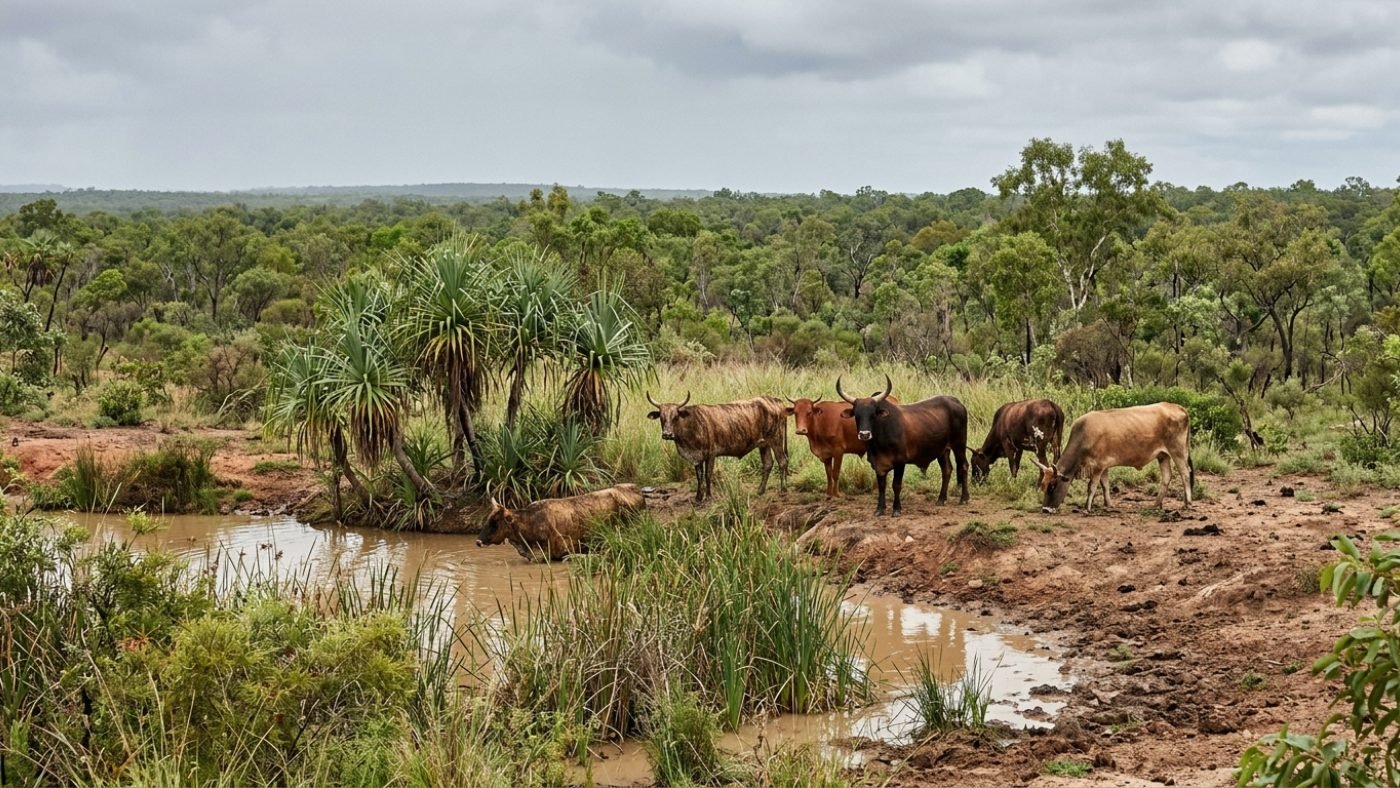
In 1849 the British landed twenty banteng — a wild ox from South-East Asia — at Port Essington on the Cobourg Peninsula, as a meat supply for a military outpost. The outpost was abandoned about a year later after crop failure and tropical disease. The cattle were left behind.
Their descendants are still there. The Northern Territory Government describes the Cobourg herd as the largest population of banteng in the world. It also classifies them as a feral pest.
That is Australian feral cattle in one story: animals that arrived by accident of empire, damaged the country they landed in, and turned out to matter in ways nobody planned.
Nobody knows how many there are
Let us be honest about this up front, because plenty of articles are not. There is no credible Australia-wide estimate of feral cattle numbers. Not from ABARES, not from the federal environment department, not from PestSmart. Regional surveys are all that exist, and even they are rough.
The best of them, with actual confidence intervals, comes from the Arafura Swamp in central Arnhem Land: an aerial survey of 3,089 square kilometres in September 2005 estimated 4,333 wild cattle (95% confidence interval 1,827 to 6,839) at a density of 1.4 per square kilometre, alongside 5,187 water buffalo. The authors added a warning worth repeating — those ranges don't account for animals the observers simply couldn't see, so the true intervals are wider still.
When the NT Government surveyed 91,658 square kilometres of Arnhem Land in June 2014, it could not produce a population estimate for cattle at all. Too few sightings. Only buffalo were estimable.
Queensland's environment department says "thousands of unbranded cattle" graze Cape York and that populations "can increase by approximately 40% annually." That second figure is a departmental claim rather than a published study, and 40% is at the extreme upper end of what cattle demography allows — treat it as a claim, not a fact.
Where they are is clearer than how many: the northern savannas — the Kimberley, the Top End, Arnhem Land, the Gulf country and Cape York.
How they got out
The mechanism is mundane and ongoing. Cattle stray off pastoral leases into unfenced country and national parks, evade mustering, and breed offspring that are never branded or tagged.
Which creates a peculiar legal knot. Because an unbranded feral beast is legally descended from someone's livestock, land managers often cannot lawfully cull it without expensive DNA testing to establish who owns it.
The buffalo took the abandoned-settlement route instead. About 80 of them were landed at Melville Island and the Cobourg Peninsula between 1825 and 1843 as a meat supply, and went bush when those settlements were given up.
The campaign that shot what it couldn't catch
The single biggest event in this story is one most Australians have never heard of.
The Brucellosis and Tuberculosis Eradication Campaign ran from 1970 until tuberculosis freedom was declared on 31 December 1997, with brucellosis freedom declared in 1989. It cost roughly $1 to $1.2 billion — over $3 billion in today's money — funded half by industry levies, a fifth by the Commonwealth and the rest by the states. The driver was blunt: protecting beef export market access after trade threats from the United States and Germany.
To certify a herd free of disease you have to test it. To test it you have to muster it. And across the Gulf and the Top End there were herds that could not be mustered at all.
The campaign's own account records "feral cattle populations that had to be controlled and/or depopulated." In the Nicholson area, a cost-benefit analysis found mustering uneconomic and authorities ran large-scale depopulation with all remaining cattle shot from helicopters.
The NT Cabinet decision of December 1982 covered 1.6 to 1.8 million Territory cattle, with 341 herds infected with tuberculosis and 94 with both diseases, on a Territory budget of $94 million. The same record puts the NT buffalo population at 280,000 — and shows government planning a 1,000-head genetic conservation herd and a 6,000-buffalo safari reserve while preparing to destroy the rest.
In Kakadu, helicopter culling took buffalo from about 20,000 down to fewer than 250 between 1979 and 1996. Nationally the herd had peaked at as many as 350,000 before the culling began.
The campaign that made Australian beef exportable was also the largest feral bovine cull in the country's history.
They came back
Roughly 40,000 disease-free buffalo were left to repopulate Arnhem Land in the mid-1990s. By June 2014 the NT's aerial survey counted 97,923 ± 9,327 across Arnhem Land, up from about 43,000 in 1998 — around 5.25% a year, doubling roughly every fourteen years. The surveyor stated plainly that this was a minimum.
The NT Buffalo Industry Council's Dr Ross Ainsworth put the herd at 200,000 to 300,000 in April 2025, about 95% of it in Arnhem Land, growing by some 37,000 calves a year.
And here is the trap. Commercial harvest costs about $400 a head plus around $150 a head in Indigenous royalties — more than the animals are worth. So instead, government spends an estimated $2.6 to $10 million a year shooting them to waste.
There is another side to that. The anthropologist Jon Altman found buffalo supplied roughly 75% of Kuninjku bush protein by the early 2000s, up from about 25% in 1981. He quotes a senior Kuninjku man: "We want the buffalo to eat, but we also want to look after our country, it's a contradiction that frustrates us."
What they do to country
Feral cattle, buffalo and pigs together have "considerable impacts on soil, water quality, waterhole hydrology, vegetation, fire regimes and the spread of exotic plants," according to a 2021 review in Austral Ecology. Sustained grazing can permanently remove key grass species, and altered fire regimes can convert grassland to woodland.
Camera traps at twenty waterholes in Limmen National Park found cattle visited about three times more often and stayed six times longer than other species, with significantly more bare ground and significantly lower bird diversity where hoofed animals had access.
Buffalo do something worse. They cut "swim channels" through floodplains that erode and then let saltwater intrude into freshwater systems. They have eliminated paperbark forests, spread the weed Mimosa pigra, and damage magpie goose and crocodile nesting.
The clearest evidence that removal works comes from Mornington Wildlife Sanctuary in the central Kimberley. A 40,300-hectare area held over 2,000 cattle and 200-plus horses and donkeys before 2004. By 2007 it was down to fewer than 200 cattle. Native small and medium-sized mammals recovered markedly within three years — 6.1 to 16.7 animals per plot in herbivore-free sites against 0.1 to 3.3 in grazed ones.
At Pungalina–Seven Emu in the Gulf country, feral cattle went from 648 recorded in 2011 to 46 in 2023.
Culling, courts and satellites
Queensland's Cape York program targeted four Aboriginal-owned national parks — Rinyirru (Lakefield), Olkola, Oyala Thumotang and Cape Melville — issuing 33 mustering permits in 2023 so landholders could recover branded stock. Removals ran to 4,009 cattle in 2021; the 2022 figure is reported as either 241 or 421 depending on which rural masthead you read.
Then it stopped. On 29 November 2024 the Supreme Court of Queensland ruled a seizure notice against Olive Vale Pastoral "invalid and of no effect." Two weeks later, on 13 December, the incoming environment minister paused the cull, stating there would be no aerial control of unclaimed and unbranded cattle in those parks that wet season pending a review of the protocol. We could find no public evidence that it has formally resumed.
Elsewhere the work continues, increasingly in Indigenous hands. The Protecting Country Against Invasive Species program, run by NAILSMA with federal funding, began in 2024 with $4 million and was extended by a further $2 million in 2026, supporting 48 Indigenous ranger groups. In 2024-25 alone it surveyed over 2.1 million hectares for feral animals and culled more than 13,250.
And then there is SpaceCows — a $4 million CSIRO project launched in September 2021 with Microsoft, NAILSMA, James Cook and Charles Darwin universities and Indigenous ranger groups. It has GPS-tagged more than 1,000 unmanaged cattle and buffalo and uses satellite tracking and machine learning to plan ranger mustering routes. Feral cattle in the Top End are now, in a small way, watched from orbit.
The banteng paradox
Back to Cobourg, because it is the strangest part of this.
Estimates of the Australian banteng herd are old and weak — about 6,000 in a 2006 Conservation Biology paper, attributed to unpublished data with no method stated, or 8,000 to 10,000 in figures circulating from 2007. No proper survey has been done since.
Whatever the number, the same 2006 paper reported that fewer than 5,000 wild pure-strain banteng remained in Asia, in scattered populations of under 500 each, after an 85% range decline over fifteen to twenty years. The feral Australian herd plausibly outnumbers every wild banteng left in its native range.
All of them descend from those twenty animals landed in 1849, with an inbreeding coefficient of 0.58 — genetically, a very narrow gate.
And the researchers found the damage banteng do at Cobourg is "considerably less than that caused by other non-native and feral species in the region such as pigs and buffalo," arguing the population is a legitimate genetic reservoir for a species failing at home.
So Australia has a feral pest that may be one of the world's most important populations of a threatened species. Both descriptions are accurate. Nobody has worked out what to do about that.
Cleanskins, scrubbers and bull catchers
Station language for these animals is precise. A cleanskin is a mature beast that has never been branded, earmarked or marked in any way. A scrubber is much the same, "usually with a bad attitude." A mickey is a young uncastrated male.
Catching them is a specialist trade. Contract bull catchers work wild country with a helicopter spotter overhead, a LandCruiser fitted with a hydraulic arm that grabs a bull by the neck, and quad riders who hobble-strap the rest. Horns are tipped and the animals branded before trucking to the meatworks. One team, working country about 400 kilometres north-west of Mount Isa, mustered over 2,000 cleanskins in a season and took seventeen bulls in about ninety minutes one afternoon. Good bulls fetched over $1,000. The nearest hospital was three hours away.
What it adds up to
Feral cattle are not brumbies. They carry none of the romance, attract none of the campaigning, and almost nobody outside the north thinks about them. But they are eating the same wetlands, and the country has spent a billion dollars and thirty years dealing with them once already.
The honest position is that we don't know how many there are, the legal framework makes them awkward to remove, killing them costs more than they are worth, and one population of them may be globally significant. For an animal nobody owns, that is a remarkable amount of complication.