
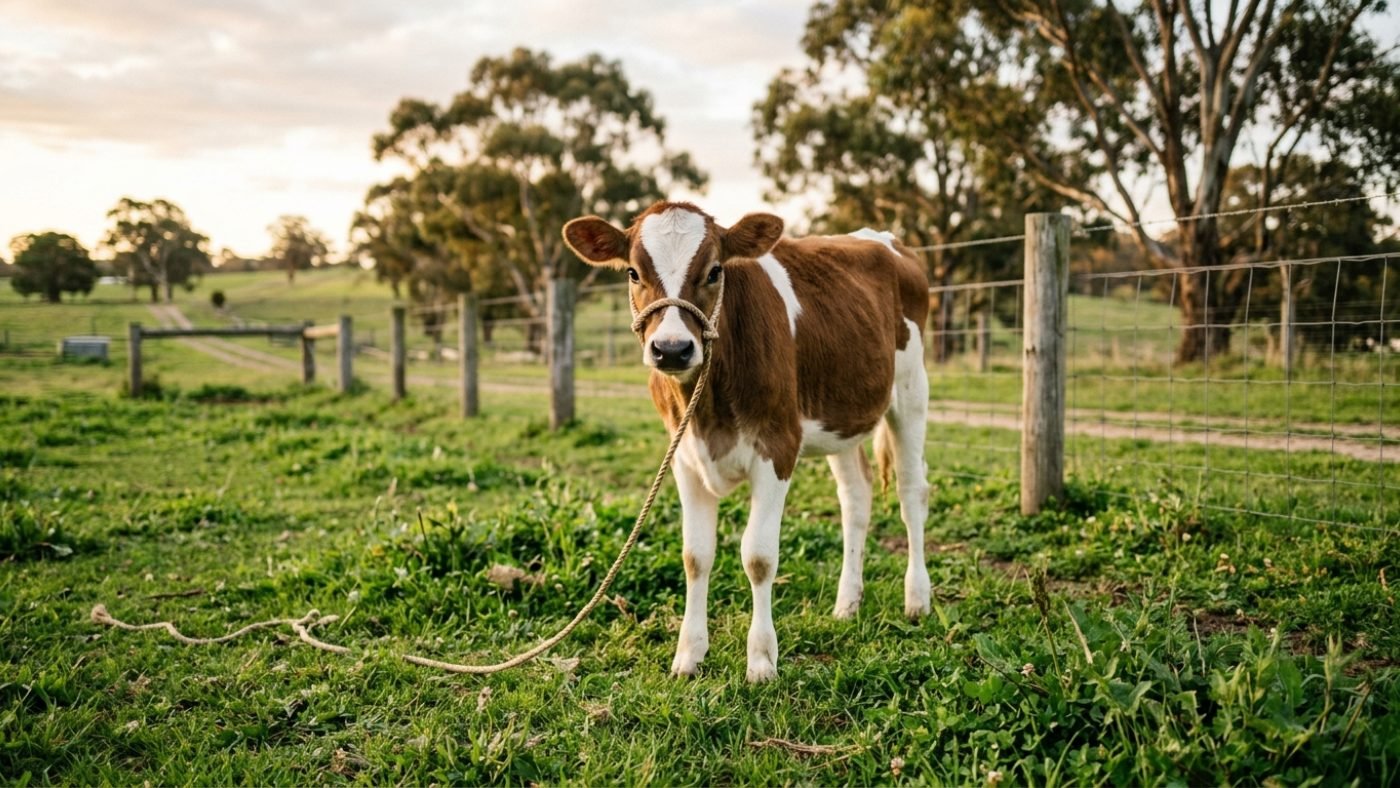
A halter-broken calf is worth more, is safer to handle, and will be an easier animal for the rest of its life. A calf that has never been handled becomes a 500 kg problem that takes two people and a race to do anything with. The difference between those two futures is about fifteen minutes a day for a fortnight.
Here's how it's actually done, without drama and without wrecking the calf's trust.
Start earlier than you think
The best window is young — but not newborn. A calf of a few weeks to a few months is small enough that you can physically hold it, still curious rather than suspicious, and not yet strong enough to drag you across the yard. Leave it until weaning and everything gets harder in proportion to its bodyweight.
Don't separate a very young calf from its mother for training. Work in a small yard where she can be nearby, or where the calf can see the mob. A panicking calf learns nothing except that halters mean fear.
What you need
- A rope halter sized for a calf — not a horse halter, which will slip and sit wrong on a calf's head.
- A small, secure yard or pen. Space is your enemy here; you want the calf unable to build up speed.
- A solid post or rail that won't move, with nothing sharp nearby.
- Gloves. Rope burn from a lunging calf is a genuinely nasty injury.
- Patience, and ideally a second quiet person for the first sessions.
Never wrap a lead rope around your hand, wrist or any part of you. If the calf bolts you need to be able to let go instantly. People have lost fingers and been dragged doing this. Hold the rope in folds across your palm, never in a loop.
Day one: touch before halter
Before a halter goes anywhere near the head, the calf should accept being touched. Stand quietly in the pen. Let it come to you — most calves are curious and will investigate within a few minutes if you're not advancing on them. Scratch along the neck and shoulder, which cattle generally find pleasant, rather than reaching straight for the face, which they don't.
Spend a session or two just on this. It looks like you're achieving nothing. You're achieving the entire foundation.
Fitting the halter
Approach from the side, not head-on. Slip the noseband over the muzzle and the headpiece behind the ears. Check the fit: the noseband should sit roughly midway between the eyes and the end of the nose, snug enough that it can't slide off, loose enough that you can fit a couple of fingers underneath.
A rope halter must be put on the right way round — the lead should come off the left side under the jaw, so the halter tightens correctly under pressure and releases when the calf yields. A halter on backwards won't release, which teaches the calf that giving in doesn't help.
Leave it on for a short period with the calf loose in the pen and supervised. Never leave a halter on an unsupervised animal or overnight — calves catch halters on rails, troughs and each other.
Tying up, and why the first pull matters
Tie the calf to a solid post at about head height, short enough that it can't get a leg over the rope. It will pull back. This is the moment that matters: the post must not move and the rope must not break. If the calf pulls back and something gives, it has learned it can escape by pulling, and you'll be fighting that lesson for months.
Stay nearby but don't intervene while it's fighting the rope. When it stops pulling and stands, that's the reward — the pressure comes off by itself. Ten to fifteen minutes is plenty for a first session.
Teaching it to lead
Leading is taught with pressure and release, and the release is the part that teaches. Apply steady, light pressure on the lead. The instant the calf takes a step toward you — even a shuffle — release completely and praise it. That release is the reward. Pulling harder is not.
Most calves take several sessions to make the connection. A helper walking behind and encouraging it forward often unsticks a calf that has planted itself. Never pull a calf forward by main force; you'll simply teach it to brace.
Once it will follow a few steps, extend gradually — around the pen, then out into a larger yard, then somewhere with distractions. Finish every session while it's still going well rather than pushing until something goes wrong.
The rhythm that works
Short and often beats long and occasional. Ten to fifteen minutes daily will get you a leading calf in one to two weeks. An hour once a week will take months and produce a worse-tempered animal. Cattle consolidate handling in small, repeated doses.
Common mistakes
- Starting too old. Every week you wait adds kilograms and stubbornness.
- Working in too big a space. Room to run is room to learn bad habits.
- Losing your temper. Cattle remember rough handling for years and become genuinely dangerous when they associate people with pain.
- Weak gear. A rope or post that fails on the first pull-back undoes everything.
- Sessions that end badly. Whatever happens last is what gets remembered. Always finish on something the calf did right.
Worth the fortnight
A halter-trained animal can be led to a float, held for the vet, moved between paddocks by one person and treated without a fight. If you're keeping a house cow, this is the single most valuable fortnight of work you'll ever put in — see our beginner's guide to keeping a house cow for what comes next.
And if you're buying rather than raising, a calf or cow that's already been handled is worth paying more for. Our pre-purchase checklist covers how to tell.