
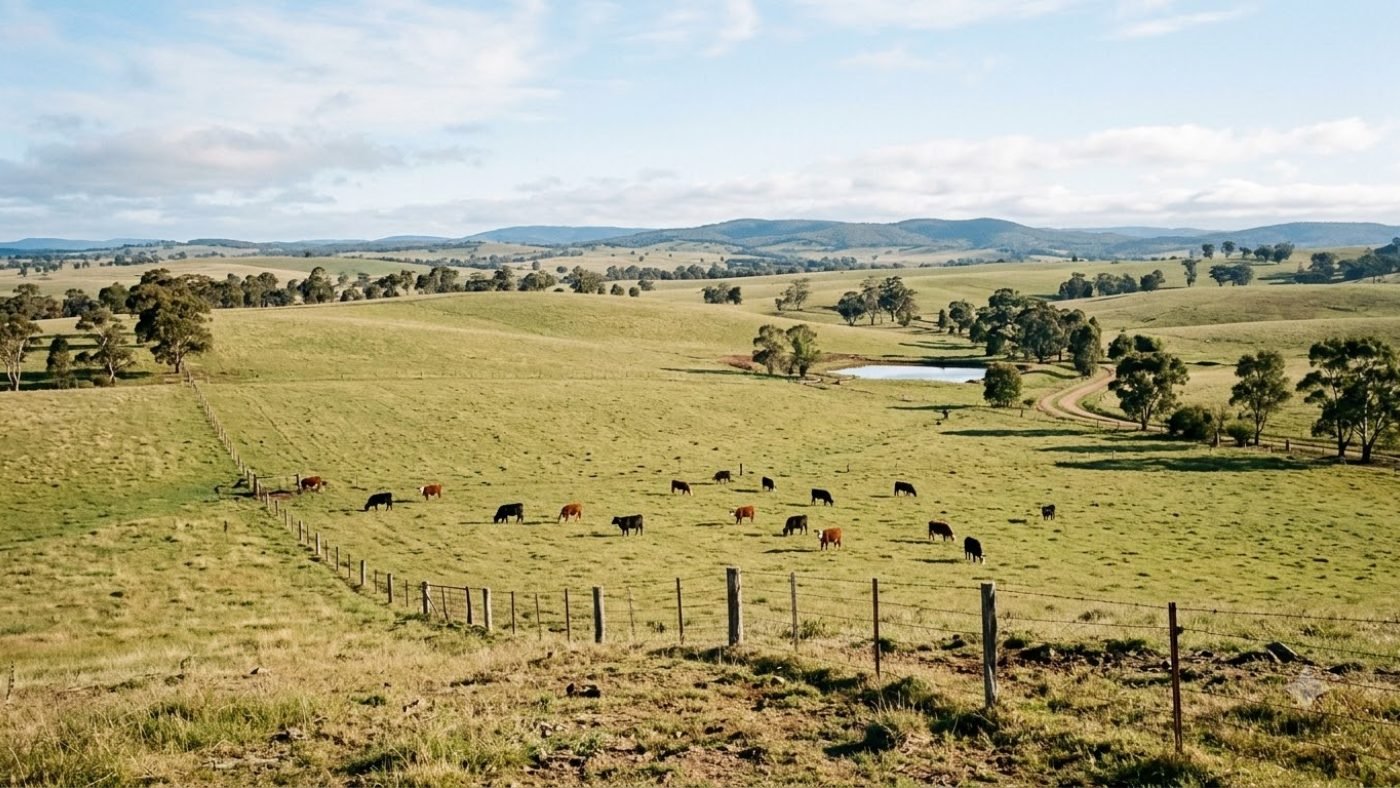
It is the first question nearly every new landholder asks, and the honest answer is unsatisfying: somewhere between one beast to a couple of hectares and one beast to forty, depending on where you are standing.
That is not evasion. Australia's published stocking rates span roughly 10 DSE per hectare down to 0.1 — a hundredfold range across the continent. Any single national number is wrong almost everywhere. What follows is how the calculation is actually done here, what the state departments publish, and how to land on a defensible figure for your own paddock.
The two units, and why there are two
Australia measures grazing pressure in animal equivalents rather than head, because a dry cow and a cow with a calf at foot eat very different amounts.
DSE — the Dry Sheep Equivalent — is the southern unit. One DSE is the energy needed by a standard wether to hold its weight and condition. Here is the first wrinkle: MLA, NSW DPI and DPIRD WA all define that standard as a 50 kg wether, while FutureBeef's material and at least one South Australian guide use 45 kg. That inconsistency runs right through official Australian extension material and nobody has tidied it up.
AE — the Adult Equivalent — is the northern unit, and it is defined more tightly: a 2.25-year-old, 450 kg Bos taurus steer at zero weight gain, walking seven kilometres a day, needing 73 MJ of metabolisable energy daily. The walking matters in rangeland country where cattle cover serious ground to water; on a small block it is irrelevant.
FutureBeef gives a conversion of roughly 1 AE to 8.4 DSE. It is the only published conversion I could find, so treat it as a rough bridge rather than an exchange rate.
The updated AE approach also revised daily intake down from 10 kg of dry matter per AE to 8 kg, with a regional range of 7.5 to 8.5. If you are reading older material, that is one of the numbers that has changed.
The cattle DSE ratings, and why they disagree
Here is where you need to be careful with anyone quoting you a single table. These are all published Australian figures:
- 500 kg dry cow: 8 DSE (MLA)
- 450 kg dry cow: 6.0 DSE (NSW DPI, Hunter)
- Dry cow or steer 350–450 kg: 8–10 DSE (SA Landscape Boards)
- Dry cow or steer: 10 DSE (a South Australian smallholder guide)
- 350 kg yearling gaining 1 kg/day: 10.4 DSE (NSW DPI)
- Cow with calf, annual average: 13.5 DSE (NSW DPI)
- Cow with calf to 8 months: 13–16 DSE (SA)
- Lactating cow at peak: around 25 DSE (MLA)
A 450 kg dry cow is rated anywhere from 6 to 10 DSE depending on which state department you ask — a 67 per cent spread on the same animal. And the cow-with-calf figures are not comparable at all: 13.5 is an annual average for the breeding unit, while 25 is peak lactation demand. Using one where the other belongs will put you badly wrong.
The practical takeaway is to use your own state's table, not a nationally averaged one, and to be clear which kind of figure you are holding.
What the published stocking rates actually are
These are real regional figures with their sources, so you can find the band your country sits in.
High-rainfall temperate southern country (NSW DPI, Hunter region):
- Unimproved native pasture, low fertility: 1.0–2.5 DSE/ha
- Native semi-improved with clover and fertiliser: 3.5–8.0
- Improved, moderate fertility: 5.0–12.0
- Improved, high fertility: 10.0–20.0
NSW regional long-term averages: Northern Tablelands 10 DSE/ha, Northern Slopes 10.3, Southern Tablelands 9.
Semi-arid Queensland mulga: soft mulga 0.2–0.3 DSE/ha, hard mulga 0.1–0.3, dissected residuals under 0.1. FutureBeef's worked example — 800 kg/ha of standing feed at 20 per cent utilisation — comes out at one DSE per 2.5 hectares.
Northern tropical black speargrass: a dry-season budget gives about 2.4 hectares per beast, and the safe-stocking example works out at one steer to four hectares.
Carrying capacity is not stocking rate
MLA frames these as supply and demand. Carrying capacity is how much feed is available. Stocking rate is how many animals are currently grazing it. Confusing the two is how people end up overstocked after one good season.
Queensland's LongPaddock service defines long-term carrying capacity as the number of livestock a property can support on average over decades — two to four full wet and dry cycles — without running down land condition. Crucially, it discounts for the condition the land is already in: B condition carries 75 per cent of what A-condition country carries, C condition 45 per cent, and D condition just 20 per cent.
This is the single most useful idea for a new landholder. The number of cattle your place will carry in a wet spring is not the number it will carry safely. Stock to the average, not the peak, and you never have to make the phone call about agisting cattle in a drought.
Soil beats rainfall on a small block
The most useful dataset I found for smallholders is DPIRD's Swan Coastal Plain table, which holds rainfall roughly constant and varies only the soil:
- Deep white sand: 0.5–2 DSE/ha
- Deep yellow or gravelly sand: 5
- Clay: 5
- Gravel: 8
- Sand–clay duplex: 8
- Alluvial brown loam and valley clays: 10
That is a twentyfold difference on the same rainfall. If you take one thing from this article, take that: what your neighbour's country carries tells you far less than what your own soil will grow. Irrigation roughly doubles these figures.
Pasture quality compounds it. One South Australian guide is blunt: if pasture is not of good quality, cut the DSE figure by at least a third.
Working it out for your place
The arithmetic is not complicated once you have the right inputs.
- Find your regional or soil-type rate from your state department — not from a blog, and not from an American source.
- Multiply by your grazeable hectares. Subtract the house paddock, the dam, the scrub and anything too steep to graze.
- Adjust for months grazed. The formula published in one SA guide is: hectares × regional rate × months grazed ÷ 12 = DSE.
- Convert to head using your state's DSE rating for the class of cattle you intend to run.
- Take off a margin. Whatever the sum says, running slightly under it is what gives you room in a dry year.
A worked example from that guide: a six-hectare block at Woodside in the Adelaide Hills, rated 10 DSE/ha, comes to 45 DSE once months grazed are accounted for — about four dry cows. On deep white sand near Perth, the same six hectares might carry one.
For the northern half of the country, Queensland's LongPaddock will generate a long-term carrying capacity report for your actual property, and MLA publishes a feed demand calculator. Both beat any rule of thumb.
What actually limits a small block
Feed is rarely the first thing to run out on a few hectares.
Water is usually the real constraint, and the numbers surprise people. Agriculture Victoria's calculator gives adult dry cattle up to 112 litres a head a day in summer, and weaners of 250–300 kg up to 70. Four cows in February is most of a small tank a week.
Grazing system matters as much as headcount. Set stocking — leaving cattle in one paddock permanently — produces selective grazing, bare patches and erosion. Rotational grazing, a period of grazing followed by a period of rest, gets more out of the same ground. On a small block the rest period is what creates the extra feed.
Supplementary feed is not a way to raise carrying capacity. The Burdekin grazing guide puts it neatly: once you are utilising more than about 30 per cent of the palatable pasture, extra supplements may be required — which is to say, reaching for the hay is a signal you are overstocked, not a solution to it.
Useful thresholds: aim to keep pasture between 1,500 and 2,500 kg of green dry matter per hectare, and take stock off below roughly 600 kg/ha, which is about two centimetres of cover. Safe utilisation is around 30 per cent on native pasture and 40 per cent on sown — MLA's southern advice is to leave 40 to 50 per cent of available feed behind.
Overgrazing, and the rules that bind indirectly
The consequences are well documented: overstocking weakens perennial grasses, lets short-lived species and woody weeds in, exposes soil to erosion and increases how much you have to feed in the dry. The Burdekin land-condition scale traces the slide — A to B loses the productive perennial grasses at 40–50 per cent ground cover, B to C is 20–40 per cent with obvious erosion, C to D is under 20 per cent with scalding.
On the legal side, I could find no Australian jurisdiction that caps cattle per hectare directly. What binds you is ground cover and catchment rules. South Australia has obliged landholders to maintain at least 70 per cent ground cover of at least three centimetres, which effectively caps stocking — though that duty sits in legislation that has since been substantially reworked, so check the current wording rather than taking it from here. MLA recommends above 70 per cent cover on flat land as good practice. Local planning schemes and catchment policies can impose more.
About “one cow per acre”
You will meet this figure constantly. I went looking for an Australian extension source behind it and found none — only commercial farm software blogs and American material.
It is a humid-temperate United States number that has drifted into Australian conversation without provenance. Given our published rates run from 10 DSE per hectare down to 0.1, it is not merely imprecise for most of this country; it is actively dangerous, because the places it most flatters are the places that punish overstocking hardest.
Use your state's soil-type table, LongPaddock's report or MLA's calculator instead. They take ten minutes and they are about your actual paddock.
Once you know how many head your country will carry, the next question is what they cost to keep — the real running costs on a small block puts numbers on the rest of it.