
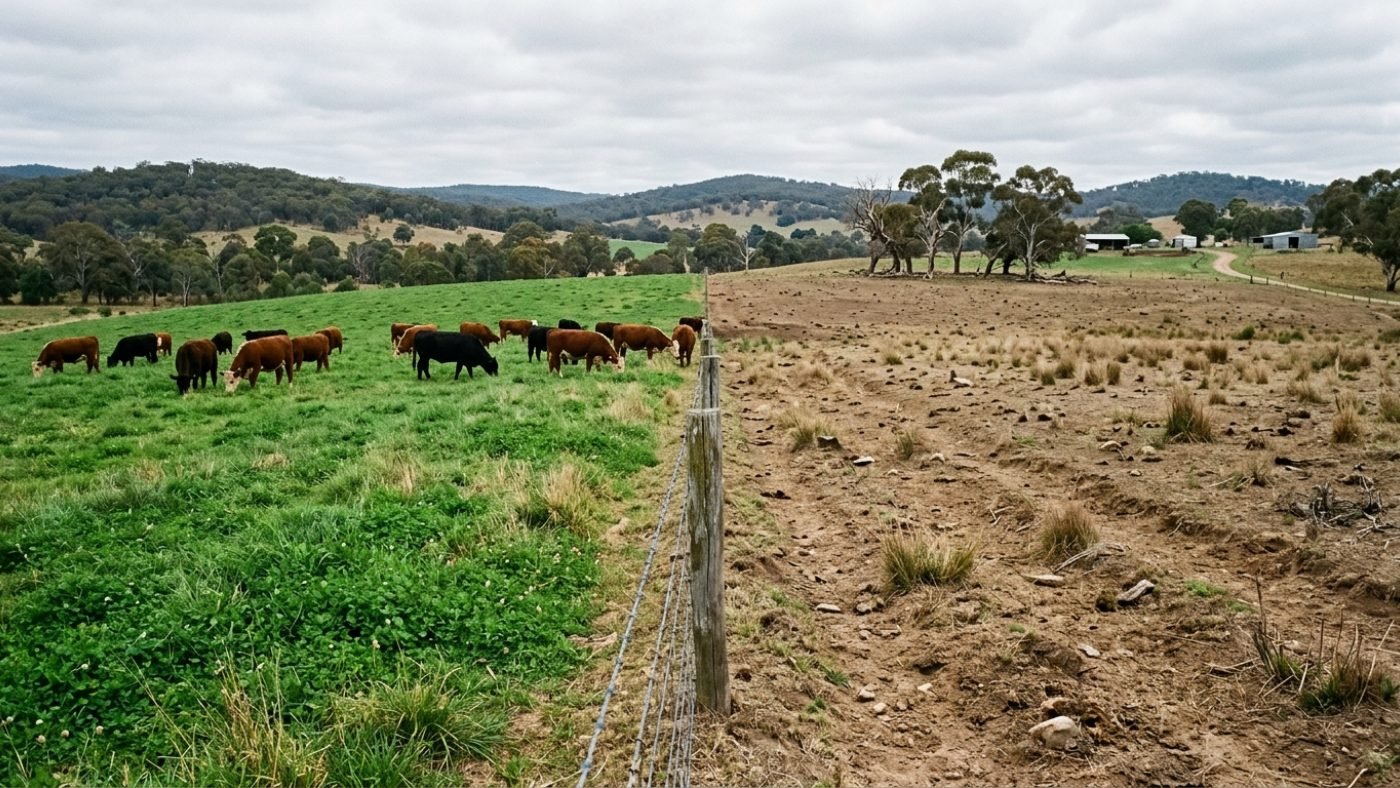
Almost every tired paddock in Australia has been tired for the same three reasons: it is too acid, it is short of phosphorus, and it has been grazed without rest. Resowing it without fixing those is the most expensive way to end up exactly where you started.
Agriculture Victoria puts it more politely: if soil fertility or grazing management are the issue, "the same problem will keep on happening". That single sentence is the most valuable thing in this article, and everything below follows from it.
Start with a soil test, and read it properly
A soil test is the only way to know which of the three problems you have. FutureBeef, the Queensland government's beef extension service, puts a comprehensive analysis at about $150 per sample through a NATA-accredited laboratory. Most commercial labs don't publish prices — expect to phone for a quote.
Sampling technique matters more than the lab you choose. NSW guidance asks for a minimum of 20 cores at 0–10 cm along a fixed transect, not randomly, so you can track the same ground over time. The CSIRO phosphorus tool is stricter again: 30 to 50 cores, exactly 10 cm deep, avoiding stock camps, tracks and wet patches, sampled at the same time each year and never within two months of a fertiliser application.
Ask for pH in calcium chloride, Colwell phosphorus, PBI (phosphorus buffering index), potassium, sulfur and organic carbon. One trap: pH measured in calcium chloride reads 0.5 to 1.1 units lower than pH in water. A soil reported at 5.0 in one unit and 5.8 in the other is the same soil. Always check which one you are looking at.
WA's department suggests testing every paddock annually for best results, with a practical minimum of once every three years, or a third of your paddocks each year.
Acidity: the slow, unglamorous problem
Pasture productivity starts to fall away once pH drops below 5.0 in calcium chloride. Agriculture Victoria's targets are to keep pH(water) above 5.3 and pH(CaCl₂) above 4.5, and to lime where exchangeable aluminium reaches 10% of cation exchange capacity. More recent government advice has shifted the target up: South Australia now nominates pH 5.5 in the top 10 cm and 5.0 in the 10–20 cm layer.
Species differ in what they will tolerate. On the EverGraze figures, cocksfoot copes down to 4.3 and perennial ryegrass to 4.6, while lucerne wants 5.3 or better and is among the species most sensitive to aluminium. Kikuyu is extraordinarily acid tolerant. If your paddock is acid and you are not going to lime it, choose accordingly.
Lifting pH by one unit typically takes 2 to 4 tonnes of lime per hectare depending on soil texture, and good liming material should have a neutralising value above 80%. The rate you spread is the lime required multiplied by 100 and divided by the neutralising value.
Lime is slow, and slower than most people think. Surface-applied lime that isn't incorporated moves down the profile at roughly 2 to 2.5 centimetres a year — so four to five years before it has meaningfully affected the top 10 cm. In trials where the top layer was held above pH 5.5, the 10–20 cm layer rose by just 0.04 pH units per year. The old rule of thumb of about 2.5 t/ha every decade is not keeping pace with acidification.
We are not going to print a lime price. Every Australian supplier we checked quotes on application, freight dominates the cost, and the only historical figure in the literature is from the late 1980s. Get a delivered-and-spread quote from a local supplier — the distance from the quarry to your gate will decide it.
Phosphorus and sulfur
Phosphorus drives root development and cell division; short plants with dull grey-green leaves and stunted roots are the classic symptom. In pasture it is usually applied as single superphosphate, which analyses at 8.8% phosphorus and 11% sulfur — roughly equal parts of both, which is exactly what a clover-based pasture wants.
How much you need depends on your soil's phosphorus buffering index, not on a single national number. The critical Colwell P value — the level expected to support 95% of maximum pasture yield — rises as PBI rises. A soil with PBI around 80 has a critical Colwell P of about 31 mg/kg; at the extremes, a PBI below 5 needs only 8 mg/kg for 90% of yield while a PBI of 500 needs 40 mg/kg. This framework was independently validated in Crop & Pasture Science in January 2024.
Here is the part that saves smallholders money. Those critical values are pegged to a target yield, and the target is not the same for everyone. WA's department sets 95% of relative yield as the target for dairy and high-production hay, 90% for intensive beef, and 80–85% for beef grazing systems. If you are running a few head on a lifestyle block, you do not need dairy soil fertility, and chasing it is a waste.
For establishing new pasture, Agriculture Victoria suggests 10–20 kg of phosphorus per hectare — 114 to 227 kg of superphosphate. Recent bulk listings for single super ranged from about $500 to $640 a tonne including GST, ex port, between August 2025 and May 2026. Those are individual trader offers rather than a national average, and they exclude delivery to your farm.
Species: what suits where
EverGraze offers a warning worth repeating: "it is difficult to generalise across regions about the requirements of different species." Rainfall, frost, soil type and drainage all move the answer. Broadly:
- Perennial ryegrass needs real rainfall — a minimum of about 700 mm in southern NSW, 800 mm in the north of the state, 900 mm on the coast. It is shallow-rooted and drought-sensitive, and it will not persist outside cool summers with even rainfall.
- Phalaris is the standout low-rainfall temperate perennial, viable from about 450 mm in southern NSW. It repays management: build to at least 1,000 kg of dry matter per hectare before autumn grazing and never take it below 700 kg.
- Cocksfoot and tall fescue fill the gaps — cocksfoot is winter-active and clumps if it is set-stocked; tall fescue tolerates wetter, poorly drained ground.
- Subtropical species — kikuyu, Rhodes grass, setaria, leucaena — are chosen on soil type and frost as much as rainfall. Kikuyu wants fertile red or black soils and performs best held at 5–15 cm. Rhodes grass suits alluvial plains, clays and granite country. Leucaena needs deep, fertile, well-drained soil, minimal frost, and careful management or it becomes a weed.
Check before you sow buffel grass. It is a mainstream productive pasture grass across much of northern and central Australia and simultaneously a declared weed elsewhere. In South Australia — declared since 2015, the first jurisdiction to do so — it cannot be sold or traded in any form, cannot be transported on a public road, and landholders in six regions including Eyre Peninsula, Kangaroo Island and the Limestone Coast are required to eliminate it. The Northern Territory declared it under the Weeds Management Act in June 2024. Always check your state's declared weed list before ordering seed.
Grazing management, honestly
Rotational grazing is where pasture advice gets evangelical, so it is worth being careful about what the Australian evidence actually shows.
In southern temperate pastures, rotation clearly helps persistence. At the Broadford grazing experiment, phalaris persisted under both simple four-paddock and intensive twenty-paddock rotations but declined significantly under continuous grazing, and rotational systems carried more perennial grass and fewer broadleaf weeds. Rotation also allowed a 10–20% higher stocking rate than set stocking, though set-stocked animals gained 5–10% better individually because they could graze selectively.
But at the Orange proof site on native pasture, there was "very little difference in composition between 1-paddock, 4-paddock and 20-paddock systems when all systems were managed according to ground cover and herbage mass benchmarks". And in northern Australia, a formal Queensland comparison of continuous, rotational and cell systems found no significant or consistent effect of grazing system on soil surface condition, pasture yield, composition or land condition — concluding that "stocking rate management, and not grazing system, is the major driver". The long-running Wambiana trial near Charters Towers says the same thing: moderate stocking sustained both productivity and profit, heavy stocking degraded the land and the returns.
The honest synthesis is that the benchmarks matter more than the number of paddocks. Aim for more than 70% ground cover on flat to undulating country (90% on steep), keep herbage mass above 800 kg of dry matter per hectare, and note that optimal pasture growth happens between about 1,200 and 2,500 kg. Hit those and the paddock count is much less important than the sales brochures suggest.
EverGraze adds the caution that matters most for a small block: the return on improved grazing management declines as the infrastructure required increases. Start with the paddocks you already have.
The leaf-stage rule
For temperate perennials, the timing tool is leaf stage rather than the calendar. Graze perennial ryegrass at three leaves, phalaris at four, cocksfoot at four to five, tall fescue at three. Dairy Australia's current guidance is to graze ryegrass at 2.5 to 3 leaves or before canopy closure and leave a residual of 4 to 6 cm between the clumps. Below 4 cm you are underfeeding and damaging the plant; above 6 cm you are wasting feed. In early autumn a leaf emerges every 10 to 15 days, so a three-leaf target implies a 30 to 45 day rotation.
None of this transfers to kikuyu, Rhodes grass or buffel. Northern guidance works on ground cover, wet-season spelling and utilisation rate instead.
Weeds: the graze makes the spray work
The main annual grass weeds of southern pastures are silver grass, barley grass and brome. They give useful cool-season feed and then turn worthless in spring, with seeds that damage hides, eyes and mouths and fault the wool clip.
Spray-topping applies a sublethal herbicide dose to sterilise seed as it forms. Well timed, it can achieve up to 95% control, with reductions typically above 85% in the following year's annual plants — but there is only about a two-week window when the seed is at the right maturity. Glyphosate goes on at flowering or milky dough; paraquat goes on later and is gentler on sub clover.
The important point is that grazing and spraying are not alternatives. Heavy grazing followed by a spell makes the seed heads emerge together, and that synchronisation is precisely what makes spray-topping work. Get the grazing right and the chemical does far more.
Some weeds are regulated and cannot simply be managed: Chilean needle grass carries a general biosecurity duty in NSW and can halve summer pasture productivity; giant rat's tail grass is a category 3 restricted invasive plant in Queensland and can cut carrying capacity by up to 80%; serrated tussock is a Weed of National Significance. Check your state's list before you plan around any of them.
Renovation, ranked
Agriculture Victoria's decision rule is usefully blunt. If more than 70% of the pasture is desirable perennial grasses, it is still productive and the job is management. Below 50%, reseeding will lift yield and feed value.
The ladder, from least to most disruptive:
- Fertiliser and grazing management alone. Cheapest, and the only option that fixes the underlying cause.
- Natural regeneration — may take 14 months or more.
- Oversowing or direct drilling. Generally the best method for introducing species; broadcasting seed before a graze is cheaper but noticeably less successful.
- Full cultivation and resowing. The most reliable and by far the most expensive and time-consuming. It germinates more of your seed and more of the weed seed bank, and it is mainly warranted where the paddock is very uneven or lime needs incorporating. Preparation should start a full year before sowing.
On cost, the only itemised Australian budget we could find is EverGraze's direct-drilled phalaris establishment at $450 per hectare — seed $134, fertiliser $80, lime and spreading $115, sprays and labour the rest — with payback falling in year 9 to 12 on a doubling of stocking rate. That was 2014, and superphosphate alone has moved a long way since. Use the structure of that budget and price the lines locally; do not use the total.
What we would actually do
Soil test. Lime if the test says to, and accept it will take years. Apply phosphorus to a target relative yield that matches your actual enterprise, not a dairy's. Fence and water so you can rest paddocks, then rest them by leaf stage or by ground cover rather than by the calendar. Give the existing perennials two seasons to respond before you spend a cent on seed.
Most tired paddocks are not dead. They are hungry and tired, and those are cheaper problems to fix than they look.