
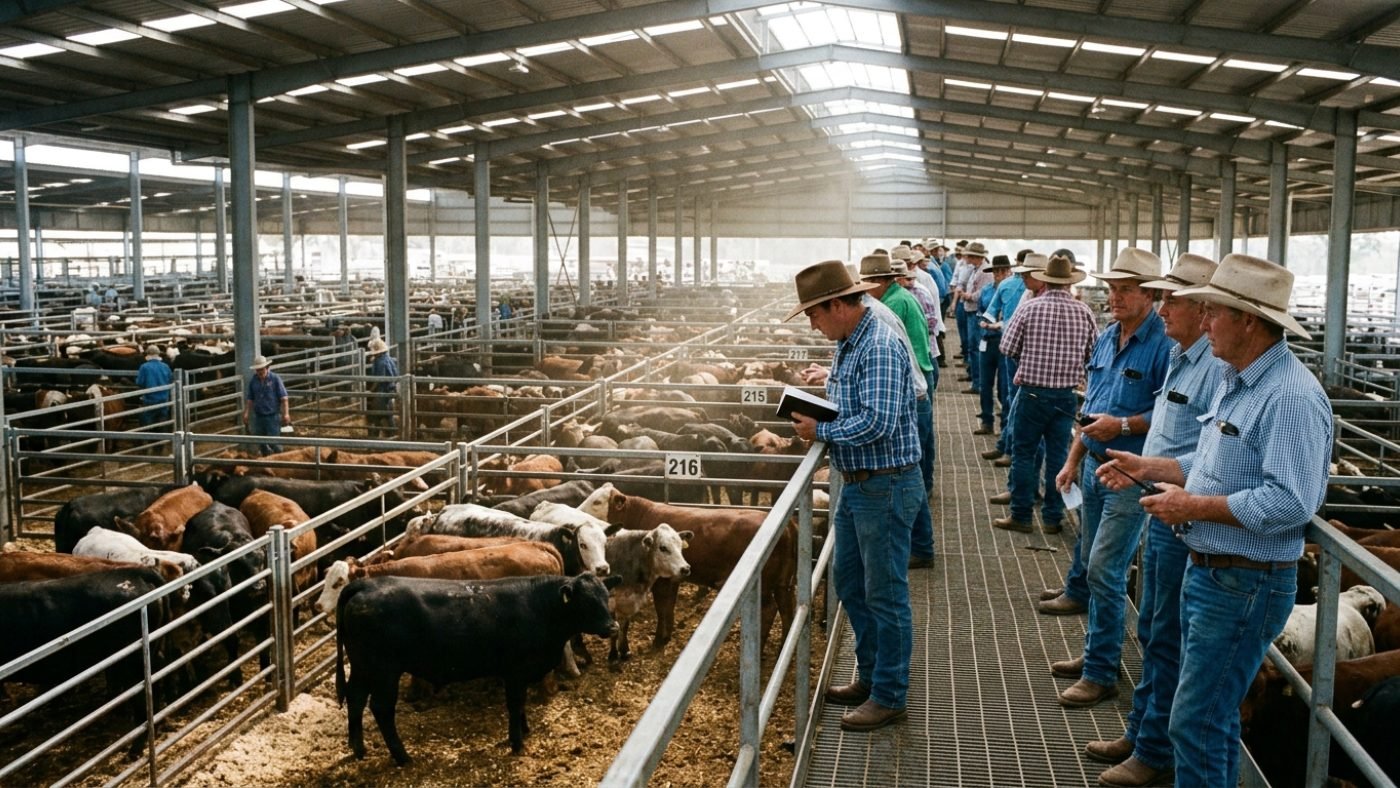
A saleyard is a strange place to watch for the first time. Several hundred people move along an elevated walkway above the pens, an auctioneer talks at a speed that seems designed to be incomprehensible, a pen of cattle is bought and sold in about forty seconds, and everyone moves three metres to the left and does it again.
None of it is improvised. Here is what is actually happening.
The day starts the night before
Every yard runs a curfew — a deadline for cattle to be delivered and settled before the sale. At CTLX Carcoar in central NSW, cattle for Tuesday's 8:30am prime sale must be in by 9pm Monday. At Wodonga, the Tuesday 8am prime sale closes its gate at 9pm Monday, and Thursday's store sale at 3pm Wednesday. Narrabri opens for delivery at 7:30am on Tuesday and shuts at 9pm for a 10am Wednesday sale.
The curfew is not just administrative. Cattle that miss it are sold on a dollars-per-head basis rather than cents per kilogram — because the yard cannot certify how long they have been off feed and water, and therefore cannot fairly weigh them.
Overnight, the animals are drafted into selling pens by weight, sex and type. A modern yard is a shed rather than a dusty paddock: CTLX has 216 cattle selling pens and roughly nine acres under roof with soft floors throughout. Wodonga's 18,000 square metre roof spans 164 by 108 metres with skylights and wood-chip flooring, on a $25 million build. The catwalk everyone calls the catwalk is officially an elevated walkway, and its purpose is to keep people and livestock separated.
How the price is made
Cattle sell either in cents per kilogram of liveweight or in dollars per head. The common belief that store cattle always sell per head and prime cattle per kilogram is not quite right — the reliable rule is the curfew one. Big store sales report in cents per kilogram routinely: at Roma's store sale on 9 December 2025, 9,455 head went through and "yearling steers 200 to 280kg sold from 342c to 600c/kg to restockers".
Most yards now weigh after the sale. You are bidding cents per kilogram on an animal whose exact weight nobody yet knows; the scale settles it afterwards and the cheque is simply price per kilo multiplied by kilos. A bid of 600 cents on a steer that weighs in at 260 kg is $1,560 a head, gross, before fees.
Pre-sale versus post-sale weighing was a genuine industry argument. The difference in recorded weight between the two systems was measured at as little as half a per cent and in most cases under one per cent.
Who is bidding, and why they value cattle differently
Four kinds of buyer work the rail, and understanding them explains most of the price spread in a single sale.
- Restockers buy cattle to put back on grass. They are buying future growth, so they bid hardest when the season is good and grass is cheap.
- Backgrounders grow young cattle to the weight a feedlot wants.
- Feedlot buyers want animals that fit a specification — weight, breed type, temperament — and will convert grain efficiently.
- Processors are buying meat. They value an animal at its carcase yield and nothing else, working back from dressing percentage: roughly 49–56% for vealers and yearlings, 53–57% for heavy steers, and a wide 38–56% for cows.
When the season is good, restockers generally outbid feeders, who outbid processors — which is why a run of rain shows up in the price of light cattle almost immediately.
The vocabulary is worth having. Store cattle are sold for breeding or further growing. Prime or finished cattle are ready for slaughter. Both terms describe the animal's stage, not its quality.
What it costs the seller
The gross price is not what lands in your account. A rough stack, using current published figures:
| Cost | Amount |
|---|---|
| Agent commission | Roughly 4–6%. Sources give "up to 5%", "3.5% to 5.5%", and one agency's terms default to 5.7% if no rate is specified |
| Yard dues (Qld council yards, 2025-26) | Roma $16.00/head, Dalby $16.57, Warwick $15.15 |
| MLA transaction levy | $5.00 per head |
| Weighing | Charged to the vendor; Charters Towers charges 0.65% of sale value per head |
| NLIS tag | From 72c in Victoria (March 2026); other states quoted at $2.50–$4.00 |
| Transport | Per kilometre, varying with truck size and numbers |
The $5 levy breaks down as $3.66 for MLA marketing, 92c for research and development, 29c for the National Residue Survey and 13c to Animal Health Australia. It is the mechanism that funds the industry's marketing and research, deducted one beast at a time.
What the commission buys, beyond the selling, is payment security: agents carry del credere insurance, which guarantees the vendor gets paid even if the buyer doesn't pay. One major agency's standard terms set the vendor's due date at seven days from the buyer's invoice.
The paperwork that can void a sale
Two systems govern every beast: the National Livestock Identification System and the National Vendor Declaration.
Tags go in the right ear only — white for cattle bred on your place, orange for anything introduced. Order them at least a fortnight ahead. The saleyard must report all movements to the NLIS database within 48 hours of the sale, and slaughter records within 12 hours.
The NVD is the food safety and chemical residue declaration that travels with the cattle. It is invalid if the handwriting can't be read, if any question is left blank, if it isn't signed, if both yes and no are ticked, if it's a photocopy, if it's been corrected with white-out, or if one form is used for more than one consignment. Corrections on paper must be made in pen and initialled; electronic ones can be fixed within 48 hours. And the declaration carries teeth: false, misleading or unverified statements may result in prosecution or civil action.
Electronic NVDs have been pushed for years but paper books remain available and no mandatory phase-out date has been announced. Every uptake figure we could verify is old — 21% of cattle consignments as at November 2023, against a 40% target. Treat claims that paper is about to disappear with some scepticism.
The indicator everyone quotes
The Eastern Young Cattle Indicator is a seven-day rolling average price for vealer and yearling steers and heifers, C2 and C3 grade, at least 200 kg liveweight, bought by restockers, processors and feedlots across around two dozen saleyards in Queensland, NSW and Victoria. It is expressed in cents per kilogram carcase weight, which is why it looks so much higher than the liveweight prices called at a sale.
Its all-time high was 1,185c/kg in January 2022. It sat at 762c at the end of April 2026, climbed through 918c in late May, and on Wednesday 10 June 2026 closed at 1,000.59c/kg — the first time above 1,000c since 2022, and nearly 290 cents above June the previous year.
That day is a neat illustration of how concentrated the market is: the Roma store sale alone made up 46% of the indicator's volume, with 5,365 head averaging 1,010.65c/kg.
You can look all of this up yourself. MLA publishes daily indicator summaries, store reports and a myMLA dashboard, reporting on more than 60 sheep and cattle sales weekly.
The big yards
MLA's National Saleyard Survey for 2024-25, published in September 2025, puts national cattle throughput at 4.84 million head across 73 reported facilities — up from 4.18 million the year before. NSW rose 22% to 1.82 million.
| Saleyard | 2024-25 cattle | 2023-24 |
|---|---|---|
| Roma, Qld | 298,085 | 250,918 |
| Leongatha, Vic | 273,202 | 159,496 |
| Dubbo, NSW | 238,000 | 180,488 |
| Wagga Wagga, NSW | 233,961 | 195,878 |
| Dalby, Qld | 230,706 | 193,763 |
| CTLX Carcoar, NSW | 188,266 | 170,399 |
| Wodonga/NVLX, Vic | 172,075 | — |
| Charters Towers, Qld | 120,779 | 83,050 |
| Naracoorte, SA | 102,005 | 86,531 |
| Ballarat, Vic | 80,122 | 55,909 |
Roma is the largest in the country. A single Tuesday there is a serious logistical event — 11,832 head were booked in for the 21 July 2026 sale, made up of 5,780 steers, 3,874 heifers, 1,889 cows and 212 bulls.
Welfare rules
The Australian Animal Welfare Standards and Guidelines for livestock at saleyards set out what animals are entitled to. Cattle must have reasonable access to water within 24 hours of arrival, where reasonable access means "an opportunity for a minimum of four consecutive hours" to drink. Animals that cannot walk, or are emaciated, dehydrated, visibly injured or blind in both eyes, must not be presented for sale. Selling pens must let every animal stand and be inspected; non-selling pens must let them move freely and lie down.
Victoria's code adds a trough allowance of 30 mm per head of cattle, water for anything held more than 12 hours, and a rule that electric prods be battery-powered with use "restricted to the absolute minimum".
One caveat worth knowing: the 2018 national standards were endorsed by agriculture ministers but have not necessarily been legislated in every state, so their legal force varies.
Are saleyards dying?
Nine Victorian saleyards closed in twenty years — Korumburra, Traralgon, Geelong, Gelantipy, Warragul, Heyfield, Warrnambool, Pakenham and Camperdown. Toowoomba's Harristown yards ran about 7,000 head a week at their peak and roughly 100 a week by early 2024, when they closed after 78 years.
Meanwhile AuctionsPlus is projected to sell around 700,000 cattle nationally in 2026, up from 660,000, with producers citing diesel prices and rising yard fees.
And yet national throughput went up — 4.84 million head against 4.18 million. Both things are true. What is happening is consolidation: fewer, bigger, roofed facilities handling more cattle, while the smallest yards close. Leongatha's 71% jump is partly Pakenham's closure arriving on its doorstep. Online selling at 700,000 head is roughly one-seventh the size of the physical yards, and growing — but it is not replacing them.
If you go
Stand on the walkway and watch one pen sell before you try to follow the auctioneer. Notice how fast the buyers decide, and how little of it is about the animals in front of them and how much is about grass, grain prices and what a processor needs on Thursday. Then look up the market report the next day and see what the pen you watched actually made. It is the quickest education in Australian agriculture available for the price of a drive.