
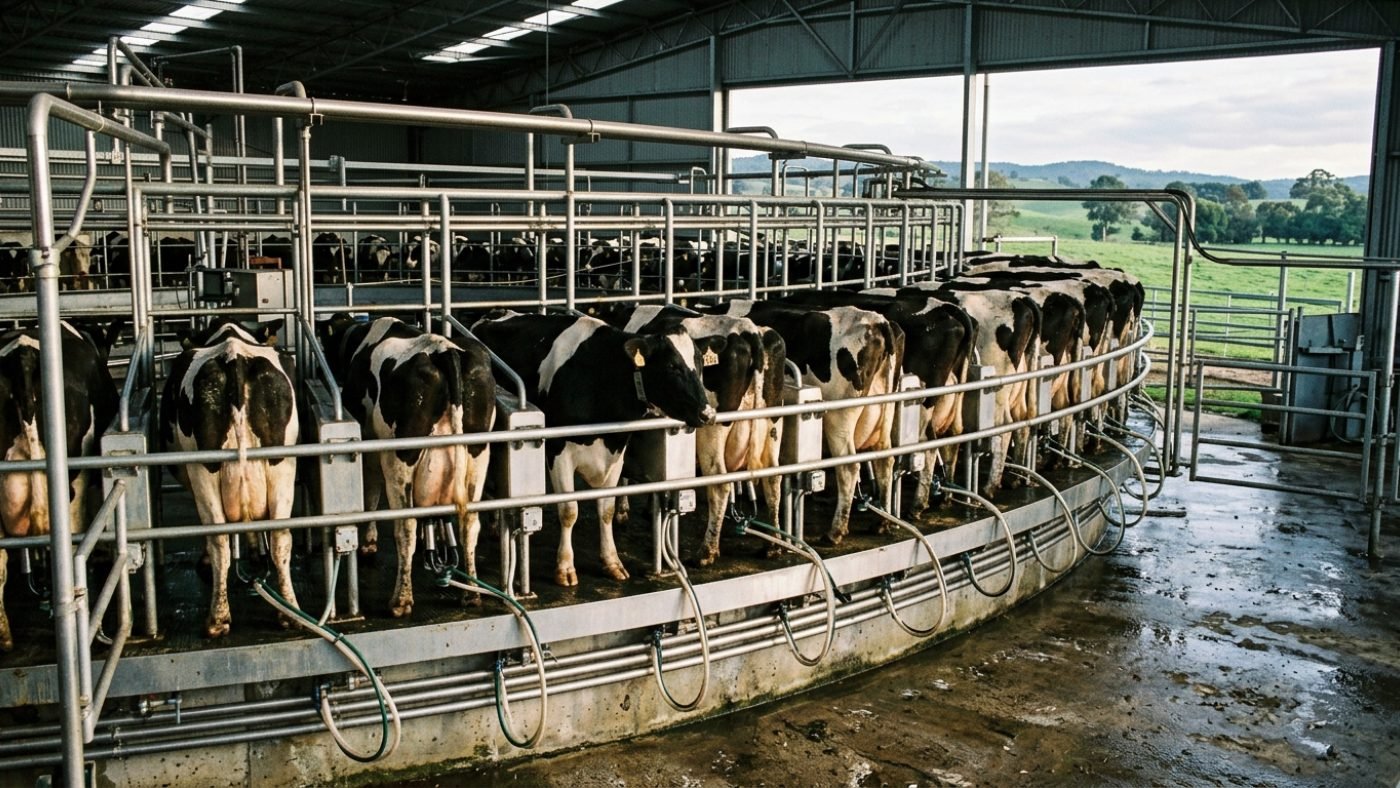
Everyone knows the story: supermarkets sold milk for a dollar a litre, and dairy farmers went to the wall. It is a good story, it is deeply felt, and the ACCC — after a full public inquiry — found it is mostly wrong.
The truth is stranger and worse. Here is how milk pricing in Australia actually works.
Farmers are not paid per litre
Start here, because almost every argument about milk prices gets muddled at this point. Dairy farmers are paid for the fat and protein in their milk — the milk solids — not the water.
Prices are quoted in dollars per kilogram of milk solids, written $/kgMS. The Australian Dairy Producers Federation uses an average Australian composition of about 7.6% milk solids (4.15% fat plus 3.45% protein), so as a rough conversion:
$/kgMS × 0.076 ≈ $/litre. A price of $9.00/kgMS is roughly 68 cents a litre. Treat this as approximate — composition varies by herd, region and season, processors pay different rates for fat and protein, and prices step up and down through the year. A single headline number hides a lot.
For the 2024-25 season, Dairy Australia put the national average farmgate price at 71.67 cents per litre, equal to $9.35/kgMS. For context, that series ran at 54.65c in 2019-20 and 52.95c in 2020-21 before jumping to 74.75c in 2022-23.
What farmers are getting in 2026-27
Processors announce opening prices from 1 June each year. For 2026-27 they ranged from $7.65 to $10.38/kgMS, averaging $9.28:
| Processor | 2026-27 opening ($/kgMS) |
|---|---|
| Coles (direct supply) | 10.38 |
| Goulburn Valley Creamery | 9.80 |
| Australian Dairy Farmers Corporation | 9.20–9.80 |
| Bulla | 9.15–9.95 |
| Bega | 9.04 (most in 8.70–9.11) |
| Burra Foods | 8.90–9.40 |
| Saputo | 8.80–8.90 |
| Lactalis | 8.65–9.45 |
| United Dairy Company | 7.65–8.45 |
Those openings are down 20 to 40 cents per kilogram on the previous season. And the United Dairyfarmers of Victoria put the cost of production in key districts at around $8.80/kgMS — meaning a large share of suppliers opened the season with, in the UDV's words, virtually no safety margin.
One thing worth knowing if you go looking: Fonterra no longer sets an Australian opening price. It completed the sale of its Mainland Group consumer and foodservice business to Lactalis on 31 March 2026. Fonterra's widely reported forecasts of around $9.75 are New Zealand prices and have nothing to do with Australian farmgate.
What you pay
Coles lifted own-brand fresh milk on 22 April 2026: 1 litre from $1.65 to $1.85, 2 litres from $3.20 to $3.55, and 3 litres from $4.65 to $5.15, citing transport, logistics and packaging costs. That works out at 185 cents a litre for the 1L bottle and 171.7 cents for the 3L.
Set the 3L price against a roughly 70 cent farmgate and the farmer's share looks like about 40%. Treat that as an illustration rather than an accounting breakdown — processing, packaging, refrigerated transport, distribution and retail margin all sit in between, and the farmgate average covers all milk, not just the milk that ends up in bottles.
The dollar-a-litre era, and what it really did
Coles introduced $1 per litre private label milk in January 2011. Woolworths and Aldi matched it within days. It ended in early 2019 — Woolworths lifted private label 2L and 3L by 10 cents a litre in February, and Coles and Aldi both followed on 19 March 2019, all three promising to pass the increase back to farmers.
Now the finding that upsets the usual telling. The ACCC's dairy inquiry, which reported in April 2018, found no evidence that supermarket retail pricing directly affects farmgate prices. Private label contracts contain pass-through clauses that let processors shift farmgate cost changes onto retailers. In the ACCC's words, farmers "earn the same regardless of whether their milk ends up as private label, or more expensive branded milk."
The Commission went further: if retail prices rose, "any additional profit would mainly be captured by the major supermarkets and processors" unless the contracts themselves changed. Paying more for milk at the checkout, on its own, did not send more money to the farm.
So what did the damage?
Buying power, one level up. The ACCC found supermarkets used their position to push wholesale prices down, that processors' gross margins on private label "generally fell, with wholesale prices approaching average production costs," and that most of the saving went to consumers rather than farmers.
The inquiry's central conclusion was about structure: "significant imbalances in bargaining power at each level" of the chain. Raw milk is generic and perishable, farmers have few alternative buyers, and — as Commissioner Mick Keogh put it — "processors use their relative bargaining power to shift risks onto dairy farmers."
There was one direct consequence. In December 2019, following an ACCC investigation, Coles paid Norco dairy farmers around $5.25 million over a 2019 price-rise pass-through.
The Dairy Code of Conduct
The inquiry's headline recommendation became law. The mandatory Dairy Code of Conduct commenced 1 January 2020, and from 1 January 2021 every raw milk purchase has had to sit under a code-compliant milk supply agreement.
What it requires:
- Processors must publish all standard form milk supply agreements on their website by 2pm on 1 June each year — which is why opening prices all land on the same day.
- A ban on retrospective price step-downs.
- A minimum price stated in every agreement.
- A 14-day cooling-off period for farmers.
The ACCC enforces it, and breaches can bring infringement notices, court proceedings and civil penalties. Small processors under $10 million turnover are exempt from most provisions but still have to act in good faith.
The second review of the Code was released just before Christmas 2025. It found the Code "appears to be operating as it was intended" and recommended keeping it, along with the step-down ban and minimum prices — but also recommended greater flexibility for processors on cooling-off periods and contract administration. Australian Dairy Farmers president Ben Bennett welcomed the outcome but objected that flexibility was proposed "despite there being no evidence the current rules are failing." By mid-2026 ADF was arguing publicly that the Code's transparency objectives "are being challenged" during the 2026-27 contracting round.
The industry is shrinking, fast
| Season | Dairy farms | Milk produced |
|---|---|---|
| 1999-2000 | 12,896 | 10,847 million litres |
| 2010-11 | 7,511 | — |
| 2014-15 | 6,128 | — |
| 2024-25 | 3,772 | 8,315 million litres |
Farm numbers fell 3% in the last year alone and are down 38% on a decade ago. The remaining farms are bigger — average herd 345 cows, 1.30 million cows nationally — and Victoria does the heavy lifting with 2,476 farms producing 63.3% of national milk.
Why do people leave? A 2023 survey of 147 Australian dairy farmers, published in Scientific Reports, found 36% were open to transitioning out of dairy. Seventy-two per cent reported major challenges, chiefly rising costs, drought and flooding, and 69% reported mental strain from long hours and low income. Ageing and health accounted for 16% of those considering leaving, labour shortages 12%, rising costs 12%.
2026 has been unkind on costs. Fuel is up around 60% and urea fertiliser over 80%, attributed to conflict in the Middle East. One Victorian supplier cited irrigation water at $315 a megalitre in April 2026.
The part almost nobody mentions
Australians drank 2,340 million litres of milk in 2024-25 — down from a peak of 2,518 million in 2015-16, and down from about 104 litres a head in 1990-91 to 85.5 litres now.
That is only about 28% of the 8,315 million litres produced. The rest becomes cheese, butter, powder and other manufactured product, much of it exported.
Which is the real reason the supermarket shelf price is a weak lever. Roughly seven litres in every ten never go near a supermarket milk fridge. The farmgate price is set mostly by international commodity returns for butter and powder, not by what Coles charges for a three-litre bottle.
When it does work
April 2026 showed the system responding. Woolworths lifted its direct farmer payment by 10 cents a litre on 14 April. Coles announced about 5 cents a litre — 66 cents per kilogram of milk solids — plus a $1 million relief pool on 20 April, paid pro-rata to more than 100 farmers. Lactalis-Mainland and Bega announced similar emergency payments.
Those are direct-supply relationships, not shelf-price effects. Which is rather the point: what reaches the farm is what someone contracts to pay the farm.
If you want to help dairy farmers, buying dearer milk is not a reliable way to do it. Buying from brands with published direct-supply arrangements, and paying attention to what the Code requires processors to disclose every 1 June, is closer to the mark.