
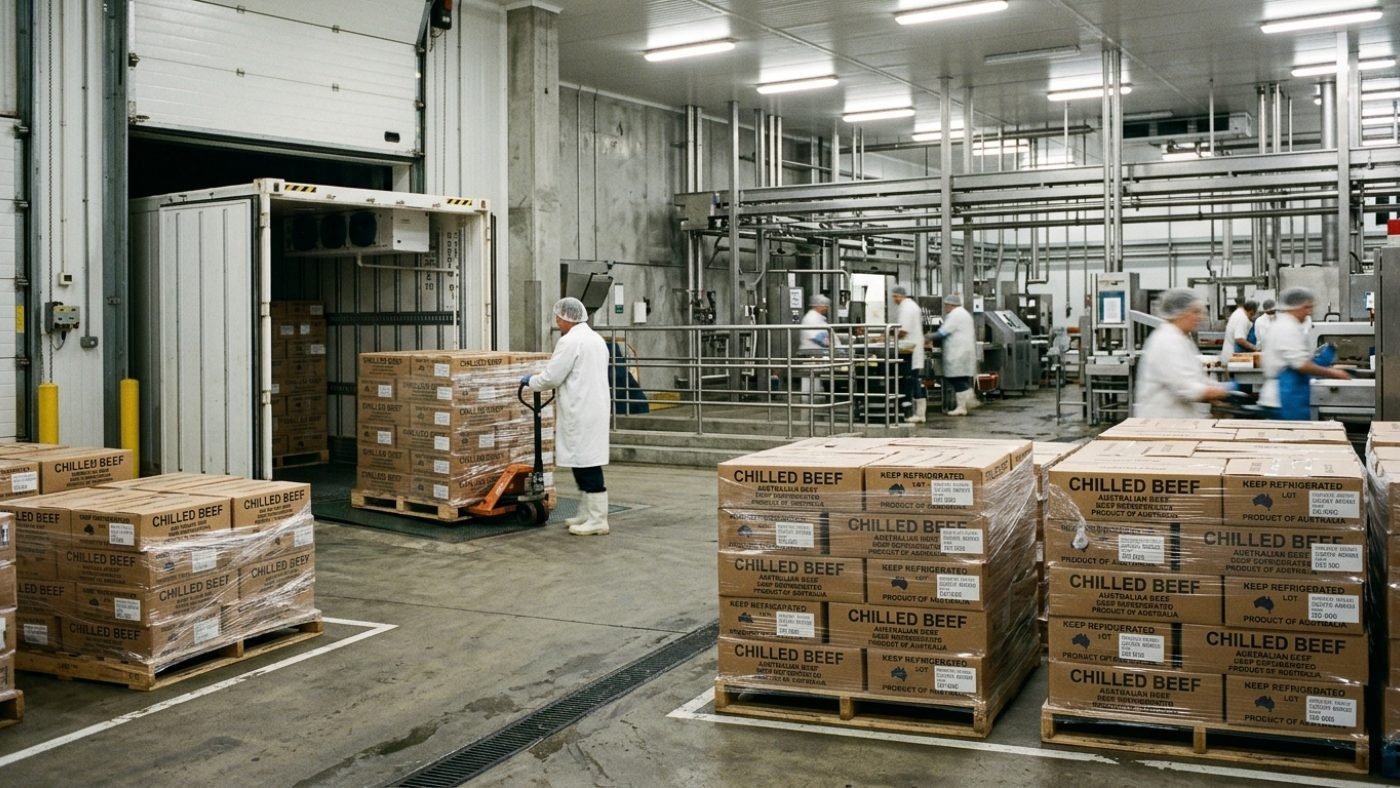
Beef and veal prices rose 13.3% in the year to May 2026. Food overall rose 3.3%. So beef ran at four times the rate of the supermarket shop it sits inside, and the Australian Bureau of Statistics said plainly why: strong overseas demand for Australian red meat.
That is the short answer. The longer one is more interesting, and it corrects several things almost everyone believes about Australian beef.
How much of it actually leaves
Australia exported a record 1,545,784 tonnes of beef in 2025, up 15% on the year before and the first calendar year above 1.5 million tonnes. It went to 83 countries and was worth A$18.2 billion, up 34%.
As a share of production, that is roughly three-quarters. Meat & Livestock Australia has variously stated 72% for 2024 and 74% for the same year, and its 2026 projections imply closer to 79%.
The most common mistake in this whole subject. You will see people divide export tonnes by production tonnes and conclude that only about half our beef is exported. It isn't. Exports are reported in shipped weight, which is boneless. Production is reported in carcase weight, which is bone in. Comparing 1.55 million tonnes against 2.87 million tonnes looks like 54%, but the two numbers measure different things. On a like-for-like basis it is about three-quarters.
Australia is the world's second-largest beef exporter after Brazil, despite not being a particularly large producer. We also eat a great deal of it ourselves — 22.4 kg per person in 2024, third in the world behind Argentina and the United States, against a global average of 6.0 kg.
Where it goes, and what each country wants
| Destination | 2025 volume | Change | What they buy |
|---|---|---|---|
| United States | 453,292 t | +15%, all-time record | Lean grassfed manufacturing beef for mince |
| China | 272,940 t | +41% | Premium chilled beef, offal, secondary cuts |
| Japan | 257,379 t | +4% | Increasingly lower-value cuts as shoppers trade down |
| South Korea | 221,350 t | +10%, volume record | Grainfed |
| Indonesia | 66,580 t | Down from 2024 record | Grainfed |
Which brings us to the second thing everyone believes and gets backwards.
"They send the good steak overseas and leave us the offcuts"
Not for the biggest customer. The United States — our number one destination — mostly buys lean grassfed manufacturing beef, largely cow and bull meat, destined to be ground into burger mince. MLA's own line is that American consumers eat an average of 36 burgers a year, many of them made with Australian beef.
It is Japan, Korea and China that take the chilled and grainfed premium cuts, and even there, a large share of the middle cuts stays home. The competition for your rump steak is real, but it is indirect. Exports bid up the price of the whole animal. They don't physically remove your steak from the shelf.
Why exporting raises the price you pay
There is only one mob of cattle. Domestic processors and export processors bid for the same animals in the same saleyards. When export demand rises, exporters can afford to pay more, and the domestic buyer has to match it or go without. As CommBank's agribusiness economist Dennis Voznesenski put it in November 2025: "Because Australia has an export-oriented agricultural industry, when export demand rises, it pushes local prices higher."
The number that anchors it is the 90CL indicator — the price of imported lean beef landed in the United States, which effectively sets what an exporter can pay for an Australian cow. In September 2025 it hit a record A$11.10 per kilogram, up A$1.83 on a year earlier and A$2.84 on two years earlier. A single 28-tonne shipping container of it was worth about A$271,000.
Why is America paying that? Because it has run out of cattle. The US herd stood at 86.2 million head on 1 January 2026 — a 75-year low, with beef cows down 1% and the calf crop down 2%.
The part that should be reassuring
Here is a fact that demolishes the usual explanation. 2025 was a record production year in Australia: 2.87 million tonnes carcase weight, from 9.28 million head slaughtered — the most since 1978. Prices rose anyway.
This is not a shortage. It is not drought. It is demand, and demand driven mostly by one foreign herd being at a three-quarter-century low. That matters, because it means the pressure can ease without anything bad happening to Australian farms. CommBank's view is that if the US and Brazil reach a trade deal and America can import more Brazilian beef, US demand for ours falls and so does the price.
So the farmers are getting rich?
Both halves of this are true and people usually only hear one.
In total dollars, 2025 was a record: producers took $20.43 billion for slaughter stock, up 25% on $15.3 billion in 2024.
But as a share of what you pay at the counter, producers are not doing unusually well. The producer's share of the retail beef dollar was 38.8% in the March quarter of 2025. That is below the 2015–2023 average of about 45%, and far below the peak near 58–60% in late 2021. It is well up on the all-time low of 25.8% in the December quarter of 2023.
In other words: farmers are doing well because cattle prices and volumes are both high, not because they are capturing more of the checkout price.
Are the supermarkets gouging?
The ACCC's Supermarkets Inquiry final report, released publicly in March 2025, made 20 recommendations and found Coles and Woolworths "considerably more profitable than comparative supermarket retailers overseas, including Walmart, Tesco, Ahold, Carrefour and Kroger." It identified real monopsony power over suppliers.
But on meat specifically, its economic analysis found something the pub version never includes: margins on the meat, poultry and seafood sections are considerably lower than on grocery, chilled and frozen, or bakery. Beef is not where the supermarkets make their best money.
The inquiry also noted, in its interim report, something directly on point here — that meat suppliers "appear to have stronger export market opportunities compared to fresh producers, which could result in these suppliers being comparatively less reliant on supermarkets." A beef producer, unlike a lettuce grower, has somewhere else to sell.
The Government responded on 3 June 2026. It rejected forced divestiture. It accepted a mandatory merger control regime from 1 January 2026, a ban on excessive pricing effective 1 July 2026 with penalties up to $10 million or 10% of annual turnover, and $67.7 million in extra ACCC enforcement funding.
Live export is a different thing, and smaller than you think
Australia exported 804,111 head of live cattle in 2025, worth over $1.03 billion, with Indonesia taking 583,345 of them. Reported mortality was a record low 0.04%.
Set that against 9.28 million cattle slaughtered here. Live export is roughly 8% of the animals turned off — a real trade, but small beside boxed beef.
The live sheep phase-out does not apply to cattle. The Export Control Amendment (Ending Live Sheep Exports by Sea) Act 2024 passed Parliament on 1 July 2024 and ends live sheep exports by sea by 1 May 2028. The Department of Agriculture, Fisheries and Forestry states explicitly that the phase-out "does not apply to other livestock export industries, such as live cattle exports," nor to live sheep by air. Nothing in that Act touches cattle.
And no, it isn't tariffs
Australian beef has been exempt from the US tariffs announced in February 2026, under a bilateral agreement struck in November 2025. Australian sheepmeat and goatmeat are not exempt. If anything the tariff story pushed the other way: duties on Brazilian beef sent American buyers toward Australian product and lifted our prices.
Where this goes next
MLA's March 2026 projections have the national herd easing 1% to 30.78 million head, slaughter at 9.45 million — the highest in almost 50 years — and production at a record 2.906 million tonnes. It reads the herd as still rebuilding rather than liquidating, but notes that the pool of lower-performing females being drawn down is finite, and projects the herd falling about 6% to roughly 28.5 million by 2028.
ABARES expects a stronger Australian dollar to weigh on returns, with the saleyard indicator averaging 705¢/kg carcase weight in 2026–27, down 9%. A dearer dollar cuts what exporters can pay — which is bad for farmers and, eventually, gentler on shoppers.
The honest summary is that you are paying more for beef because Australia produces roughly three times what it eats, sells the surplus into a world that currently wants it badly, and lets one price form for everybody. That arrangement has kept a lot of rural Australia employed for a long time. It also means that when America runs short of cattle, it shows up in Brisbane at the butcher.