
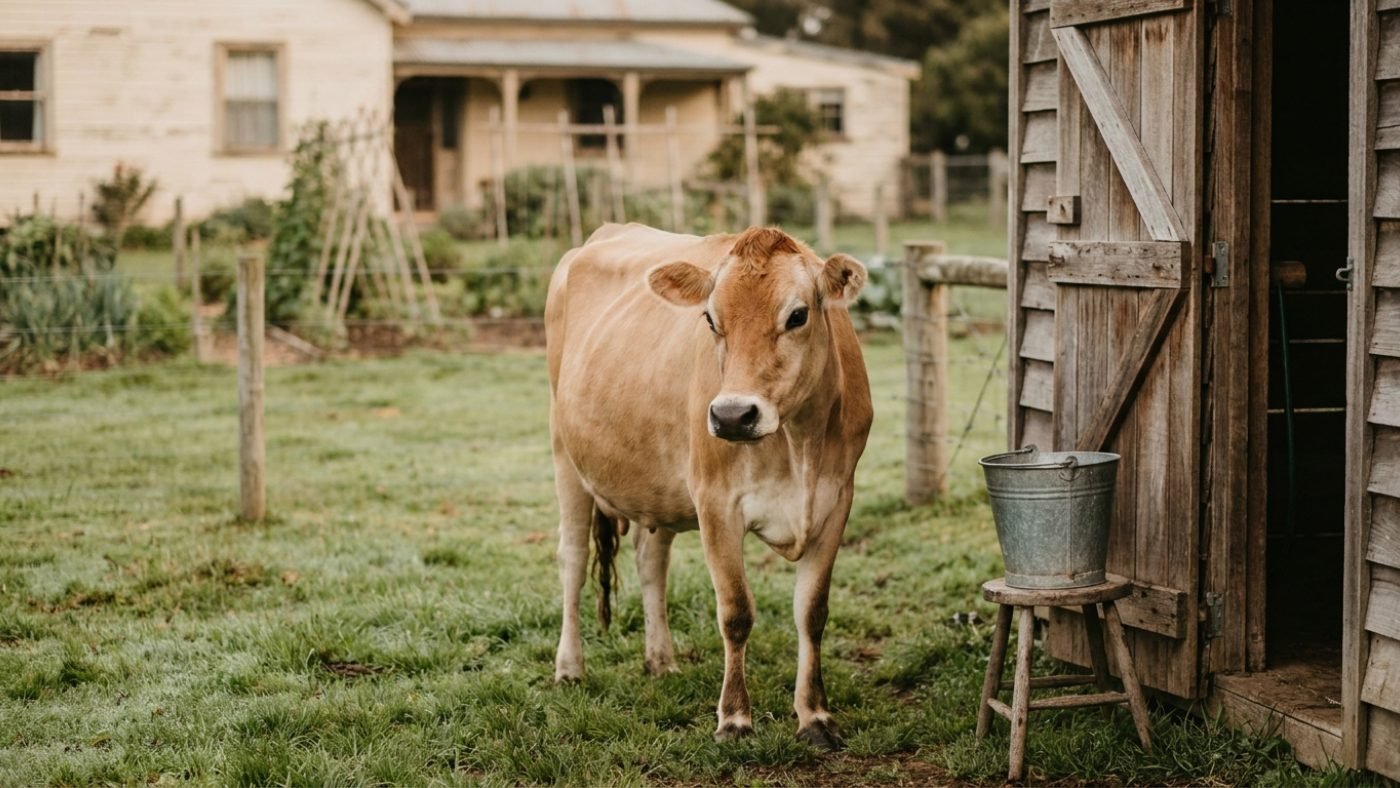
There's a particular daydream that catches people somewhere between their second vegetable bed and their first chook pen: a gentle cow in the paddock, a bucket of warm milk on the kitchen bench, butter and yoghurt made with your own hands. It's achievable on a lot of Australian blocks. It is also the largest commitment in backyard farming — more demanding than bees, chooks and goats combined, and the only one where getting the numbers wrong can leave an animal standing on bare dirt in February.
So this guide leads with the numbers. What she needs, what it costs, and the four things that go wrong in the first year.
How much land? More than you've been told
You'll see "one cow per acre" repeated on forums. For most of Australia it's roughly three to four times too optimistic.
The most citable Australian figures come from NSW DPIRD's beef gross margin budgets (June 2026). On the coast, running improved pasture, their model carries 100 cows on 173 hectares — about 1.7 ha, or 4.3 acres, per cow unit. Inland, on semi-improved native pasture, the same 100 cows need 372 hectares — 3.7 ha, or 9.2 acres each. Same animal, more than double the country, purely because the grass is different.
A "cow unit" in those budgets includes her calf and a share of the bull, so a single house cow needs somewhat less. But she's also lactating, which lifts her energy demand well above a dry beef cow's. Treat around 1.5 to 2 hectares (4–5 acres) of genuinely good improved pasture as a working minimum on decent coastal or irrigated country, and expect to need considerably more inland — plus hay through the dry months either way.
Worth knowing: no Australian state agriculture department publishes a minimum land area for a single house cow. If someone quotes you one as though it's official, it isn't. Ring your local Landcare group or department district agronomist and ask what your district carries — that's the answer that matters, and it's free.
One more thing on numbers: cattle are herd animals. A cow kept entirely alone is often stressed, noisy and hard on fences. A companion — a steer, a second cow, even sheep or a quiet pony — makes for a settled animal.
Water: the figure people get badly wrong
A milking cow in hot weather can drink far more than newcomers expect. Dairy Australia's guidance is to allow up to 250 litres per cow per day in hot conditions, against a more typical 125 litres. Cows also drink in large gulps right after milking — up to 40 litres in the couple of minutes afterwards.
Size your trough, tank and pump for the February heatwave, not the September average. A 500-litre poly trough runs about $375, a 5,000-litre poly tank around $1,340, and a solar bore pump kit starts near $2,700 plus GST if you're pumping from a bore. Running out of water is the one mistake with same-day consequences.
Which breed makes a good house cow?
You want a smaller, quiet dairy animal with a manageable supply.
Jersey is the classic choice — small, rich milk, and generally good-natured once handled. Be realistic about volume, though. The Australian all-breed average is around 16 litres a day across a whole lactation, but a freshly-calved Jersey bought out of a commercial dairy commonly peaks in the 25–30 litre range. Most beginners are overwhelmed by milk, not short of it, which is why share-milking with the calf or once-a-day milking matters from the start.
Dexter is a small dual-purpose Irish heritage breed — not a "miniature" breed, despite how it's often sold. They suit small blocks well, but there's a genetic issue you must understand before buying, and it's covered below.
Jersey or Guernsey crosses are often cheaper, hardier, and widely available out of dairy districts.
A full-size Holstein is not a beginner's house cow at any price. She's a professional athlete who needs professional feeding. For more on breeds generally, see our guide to ten cattle breeds on Australian farms.
Dexter buyers, read this. Dexters carry chondrodysplasia — the "bulldog" gene. Mating a short-legged Dexter to another short-legged Dexter produces a lethal deformed calf in roughly 25% of matings. Dexter Cattle Australia maintains a long/short classification precisely so buyers can avoid it. Since a house cow needs joining every year, this is not a theoretical risk. Ask for the classification of both your cow and any bull before you breed.
What she needs before she arrives
- Fencing. Four to five plain wires with at least one electrified, or ringlock with a hot wire on top. Four plain strands and a bored cow is a fence-walking problem. Budget around $1.70 a metre for 8/90/30 ringlock, $7.50–$9.50 per star picket, and roughly $430 for a mains energiser rated to a small block.
- Shelter. Shade trees or a simple shed. Heat knocks milk production quickly.
- A milking spot. Nothing elaborate — a small yard or bail with a rail to tie to, somewhere dry, with room for a bucket and a stool. A head bail makes life much safer.
- A vet who does cattle. Find them before you need them. Most rural practices don't publish prices; ring two or three and ask what a farm call costs in your area.
- A PIC and NLIS tags — see the next section.
The paperwork, done properly
Even one cow on a hobby block brings legal obligations, and this is where first-timers most often end up unknowingly non-compliant.
You need a Property Identification Code (PIC) for any property keeping livestock. Note that a PIC isn't necessarily free or permanent — in NSW, for instance, it's typically renewed every three years and attracts a fee unless it's covered by your Local Land Services rates. Check your own state's rules rather than assuming.
Then the NLIS side, which is more than just a tag:
- Cattle need an NLIS device before they move off a property.
- The buyer must record the movement on the NLIS database — within 48 hours in most states.
- Both parties keep the vendor declaration or waybill for at least two years.
Electronic National Vendor Declarations (eNVDs) are free through Integrity Systems. If you plan to ever sell an animal or send one to an abattoir, LPA accreditation ($90) is worth having.
Health: the four things that actually go wrong
1. Vaccination — and why "annual" isn't the whole story
The standard cattle vaccine is 7-in-1, covering five clostridial diseases plus two strains of leptospirosis. The part that gets skipped: a previously unvaccinated animal needs two doses, four to six weeks apart, before she moves onto annual boosters. One shot a year on a cow who's never been done leaves her unprotected.
Time the annual booster for four to six weeks before calving. That's what passes protection to the calf through the colostrum.
There's a second reason this matters more for a house cow than for beef cattle. Leptospirosis is transmissible to humans, and the two highest-risk activities are milking and drinking raw milk — which is precisely what you'll be doing every day. The lepto component of that vaccine is as much a human health measure as an animal one.
On cost: 7-in-1 runs roughly $3.60 a dose in a 50 mL pack but about $2.40 in a 250 mL pack. With one cow you'll never use 125 doses before expiry, so you pay the top rate — one of many small-holder penalties. Ask your vet or a neighbour about splitting a bottle.
2. Mastitis
Udder infection is the most common way a house cow's productive life is cut short, and quarters lost to it don't come back. Strip the first squirts from each teat onto a dark surface or a strip cup before every milking and look for clots, flakes or watery milk. Watch for heat, hardness or swelling in a quarter. Keep the bail clean, wash and dry teats, and treat early — mastitis caught on day one is a different proposition from mastitis caught on day four.
3. Milk fever
Hypocalcaemia around calving can put a cow down and kill her within hours. Jerseys are the highest-risk breed, which is awkward given they're also the most popular house cow. Signs are unsteadiness, cold ears, muscle tremors and eventually going down and staying down, usually within a day or two of calving. Talk to your vet about pre-calving management and keep their after-hours number where you can find it at 5am.
4. Worms and drenching
Adult cattle develop substantial immunity to gastrointestinal worms. Blanket-drenching a healthy adult cow every year is generally unnecessary and helps drive drench resistance. Young stock are the ones that need a worm plan. Get a faecal egg count rather than guessing.
Withholding periods. Every drench, antibiotic and some vaccines carry a meat and/or milk withholding period — the time you must not drink the milk or send the animal for slaughter. These vary by product and change with label updates, so read the label on the bottle in your hand and confirm with your vet. Don't take a withholding period from any website, including this one.
Milk means calves — and calves mean decisions
A cow doesn't give milk because she's a cow. She gives milk because she has had a calf, and she needs one roughly every year to keep going. That means arranging a bull or an AI technician annually (dairy semen straws run about $18–$35 plus GST, or $42–$56 for sexed), a nine-month pregnancy, and a plan for each calf. Half of them will be bulls. Decide what happens to them before she's joined, not after.
Most house-cow keepers share-milk: the calf stays on and takes some of the milk, you take the rest, and you can skip a milking by leaving the calf on. It's by far the most forgiving system for beginners.
You'll also need to dry her off — stop milking roughly two months before her next calving, so she can put condition on and regenerate udder tissue. Milking straight through to calving is hard on the cow and on the next lactation.
Raw milk: the honest bit
Milk straight from your own cow is one of the real pleasures of the thing. It also carries genuine risk. Unpasteurised milk can carry Campylobacter, Shiga toxin-producing E. coli, Listeria, Salmonella, Q fever and leptospirosis. The people most likely to be seriously harmed are young children, pregnant women, older people and anyone immunocompromised.
Reduce the risk with clean milking, rapid chilling and short storage — or pasteurise at home, which is a pot, a thermometer and a few minutes. Note also that selling raw milk for human consumption is prohibited in Australia. Milk from your cow is for your household.
What it costs to feed her
NSW DPIRD's June 2026 budgets put a beef cow's total variable costs around $363–$384 a head per year at commercial scale, with animal health only $25–$42 of that. A single house cow will cost more per head, because you lose every economy of scale.
Hay is the volatile line. A 450 kg cow at maintenance eats roughly 7.5–8 kg of hay a day, and add 20% in cold weather. At the round-bale prices common in mid-2026 — roughly $200–$330 a tonne — that's about $1.55–$2.55 a day. Buy the same hay as small square bales through a produce store and you can pay three to eight times as much per tonne. Over a 120-day winter the difference is a few hundred dollars versus well over a thousand.
And hay prices move violently. South-west Victorian pasture hay went from $260 a tonne in December 2024 to $645 by July 2025 — then back to $355 by October. Budget for a bad year, not an average one.
Five mistakes that catch first-timers
- Buying an unhandled cow. Pay more for a quiet, halter-broken animal someone has actually been milking. You'll spend the difference on bruises otherwise.
- Skipping the companion animal. Lonely cows bellow, pace and test fences.
- No plan for the calf. Half are bulls. Decide early.
- Underestimating summer. Feed and water demand can double when the grass browns off.
- No relief milker. Line up your backup before the first milking, not before your first holiday.
Start with someone else's cow
The best first step isn't buying an animal — it's finding someone nearby who already keeps one and offering to help with a fortnight of milkings. You'll learn more from that than from a month of reading, and you'll find out whether you actually want to be tied to a 5am routine before you own the obligation.
Then, when the right quiet Jersey turns up, you'll know exactly what you're taking on.
Want the other end of the scale? Read what it's really like living on a cattle station, where the herd is counted in thousands.
This guide is general information, not veterinary advice. Animal health decisions, vaccination programs and withholding periods should be confirmed with your own vet, and legal requirements with your state department of agriculture or primary industries.