
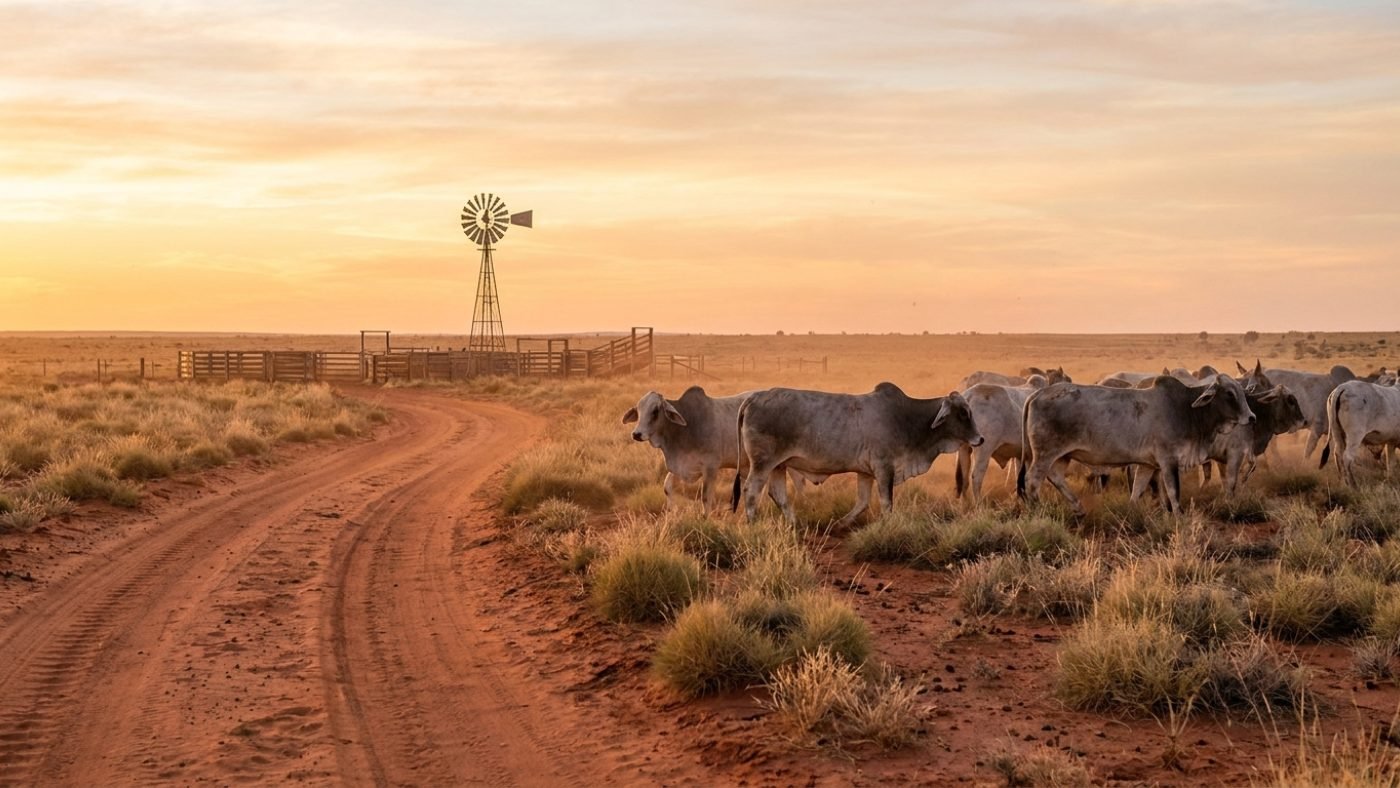
Start with the scale, because nothing else makes sense without it. An Australian cattle station isn't a farm with extra paddocks. Anna Creek in South Australia covers 23,677 square kilometres — larger than Israel, and roughly the size of Wales. Plenty of Northern Territory stations run to several hundred thousand hectares without anyone thinking them remarkable.
That scale sets everything else: the working day, the school run, the social calendar, what's in the freezer, and how long it takes an ambulance to arrive. Here's what daily life actually looks like.
The day starts before the heat does
Station days run on sunlight and temperature. Through the dry season the serious work happens early — breakfast in the dark, a quick meeting at the shed while bikes and horses are readied, everyone moving by first light. As the mercury climbs past the middle of the day the crew shifts to yard work, fencing, or something in the workshop.
There is always something in the workshop. A station is a collection of bores, pumps, fences, troughs and vehicles, all of which fail, usually several at once and always a long way from the shed.
One note on the imagery: the quad bikes of a decade ago have largely given way to side-by-sides and two-wheel ag bikes. Operator protection devices became mandatory on quads in 2021 and several corporate pastoral companies have banned them outright.
Mustering is the year's main event
Once or twice a year every animal on the place has to come in — to be counted, weighed, branded, vaccinated, weaned or drafted for sale. On country this size that's a logistical operation, not a morning's work. Helicopters push mobs out of scrub and gullies toward riders on horses and bikes, who walk them — sometimes over days — into the yards.
It's dusty, loud, physically punishing and, by most accounts of people who've done it, the part they miss when they leave. It's also when the station earns its money: the road trains hauling sale cattle out are the year's pay cheque.
School happens in a room down the hall
There's no bus when the nearest town is three hundred kilometres away. Station kids do their primary schooling by distance education, and for many families that means School of the Air — which is very much still operating, not a museum piece. Alice Springs School of the Air, Katherine School of the Air and School of the Air Broken Hill all run today as government schools.
What has changed is the technology. The first official lessons went out on 8 June 1951 over pedal-powered wireless sets. Today it's satellite internet and video lessons. Most families employ a governess — a "govie" — or a parent supervises the schoolroom for a few hours each morning. Come high school, most kids head to boarding school in the city, and the house gets very quiet.
Who actually lives out there
More people than you'd think, and the job titles are more precise than outsiders assume.
A ringer is a stockman — often an experienced one. A head stockman is a ringer who's been doing it for years. A jackaroo or jillaroo, by contrast, is the trainee position, historically on the management track. Mixing the two up is a reliable way to mark yourself as someone who's never worked on a station.
Beyond the owner or manager's family, a decent-sized station employs a crew: ringers, jackaroos and jillaroos, a cook, a bore runner, often a mechanic and a govie. They mostly live in shared quarters, eat together, and become something between workmates and family over a season.
The nearest neighbour is a long drive away
Isolation is real, but it isn't the loneliness city people picture. The bush social calendar is surprisingly crowded — campdrafts, rodeos, race meetings, gymkhanas and clearing sales are as much social events as sporting ones, and people will drive four hours each way for a good one.
When something goes wrong — a fire, a flood, an injury — those same distances collapse. Everyone comes.
The wet season rewrites the rules
Across the north the year splits cleanly in two. The dry runs roughly May to October and is when the work gets done. The wet runs November to April, when storms turn black-soil roads to grease and parts of a station can be cut off for weeks at a stretch.
Households prepare accordingly: a cold room stocked before the roads go, a freezer full of beef, and a mail plane or a long drive for anything urgent. The wet is also the year's payment — grass comes away green, waterholes fill, and the country carries the herd through the next dry.
Food comes a long way
Station kitchens feed hard-working people from a very long supply line. Groceries arrive by mail truck or a monthly town run, so cooking leans on staples, a serious vegetable garden if the water allows, and the station's own beef. Many properties still process a "killer" — an animal raised for the house — which keeps the freezer stocked. Nobody on a cattle station goes short of steak.
The honest bits
Droughts stretch bank accounts and nerves for years at a time, not months. The work is physical and genuinely dangerous — cattle, horses, bikes and machinery, often hours from a hospital. The Royal Flying Doctor Service is a working part of the health system out there, not a piece of folklore. And the isolation puts pressure on relationships and on mental health, which the industry has become considerably more willing to talk about in the last decade.
Station people tend to be matter-of-fact about all of it. The trade — space, animals, self-reliance, a community that turns up when it counts — is one they make with their eyes open.
Could you do it?
Station work remains one of the few jobs a newcomer can still walk into. Properties across the north hire seasonal crew every year, and while experience helps, attitude and a willingness to be useful matter more. Plenty of people describe a station season as the hardest and most formative year they've had.
If you'd rather start considerably smaller, a single quiet Jersey in a home paddock is its own education — we've written a beginner's guide to keeping a house cow for exactly that. Curious about the animals themselves? Meet ten breeds you'll find on Australian farms.