
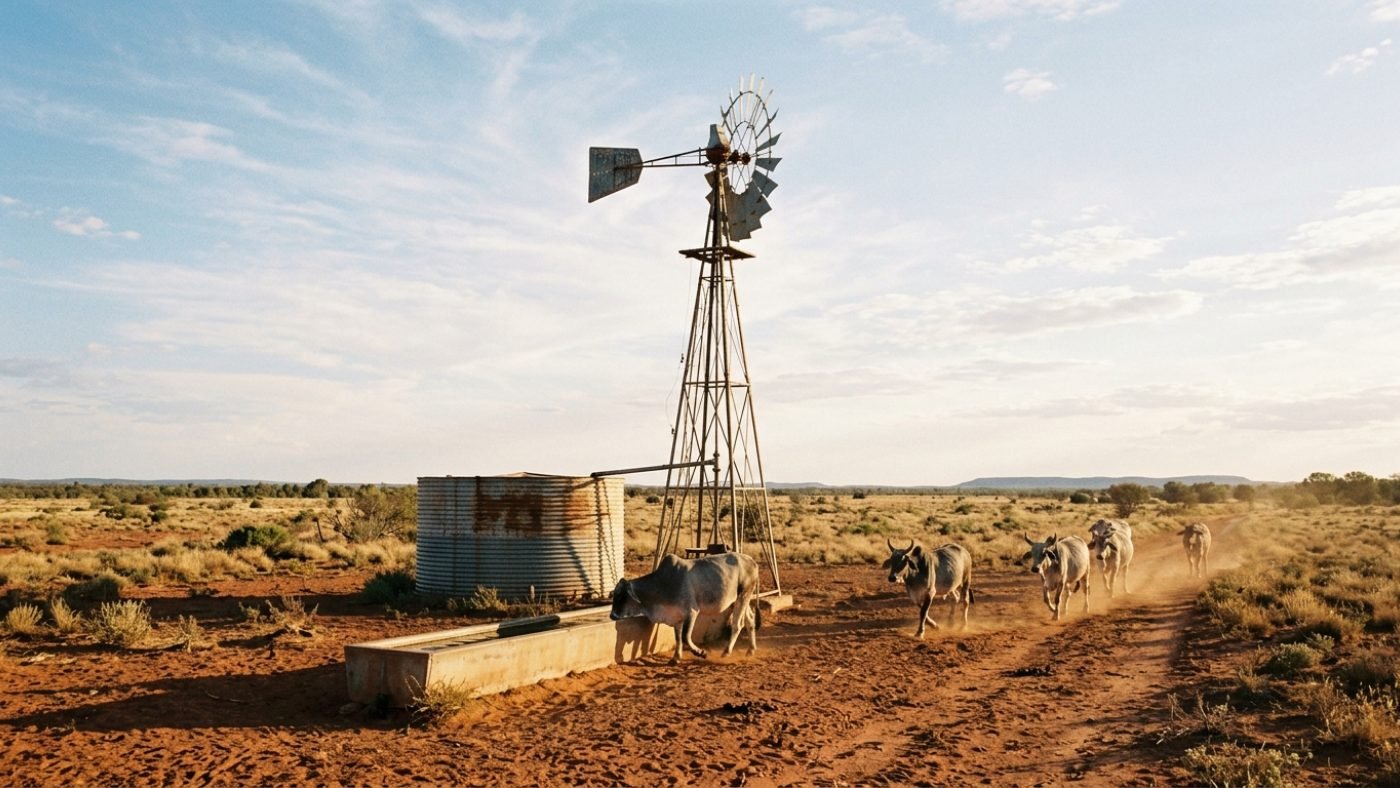
Australia's inland cattle country is not limited by grass. It is limited by water. Rain falls, grass grows, and none of it is worth anything if cattle cannot drink within a couple of kilometres of where they graze.
The story of how that problem was solved — and then half-unsolved, and is now being solved again — is one of the more remarkable pieces of Australian engineering, and almost nobody outside the bush knows it.
The basin under a fifth of the continent
The Great Artesian Basin sits beneath almost 1.7 million square kilometres of Queensland, New South Wales, South Australia and the Northern Territory — somewhere between a fifth and 22% of Australia, depending on which government page you read. The federal environment department and Geoscience Australia both put the stored volume at 64,900 million megalitres.
Water enters along the recharge zones and moves through the aquifers extraordinarily slowly, arriving under enough pressure in places to push itself to the surface without a pump. That is what artesian means, and it is why the basin transformed grazing in the driest parts of the country.
The first artesian bore was drilled in 1878, about 180 kilometres south-west of Bourke in New South Wales, striking flowing water at 44 metres. By 1899 there were 524 bores, 505 of them productive. By around 1915 more than 1,500 free-flowing bores had been sunk.
Then the pressure started falling
Concern arrived within about a decade of the boom. Queensland twice put water-waste control legislation to its parliament in the 1890s and had it rejected by the upper house; a similar New South Wales bill failed in 1894.
Basin discharge peaked at roughly 2,000 megalitres a day around 1918. Between the 1880s and the 1990s, pressure drawdowns of up to 100 metres were recorded in closely developed areas. Flowing bores stopped flowing. Mound springs — the desert oases the basin feeds, some of them of deep cultural significance — declined.
The waste was structural rather than careless. Water came out of an uncontrolled bore and ran away down open earth drains, sometimes for kilometres, so that cattle could drink anywhere along the line. Up to 95% of that water was lost to evaporation and seepage before an animal got near it.
Counting the bores is genuinely contested. The Strategic Management Plan counts 50,475 bores in total with about 9,000 artesian; other published estimates put the free-flowing artesian count at around 6,600, or at about 4,700 into the main Jurassic–Cretaceous aquifers plus some 25,000 shallower non-flowing artesian bores, generally windmill-pumped. Roughly 50,000 bores in total, of which several thousand flow under their own pressure, is as precise as the public record honestly allows.
Capping and piping
Queensland began rehabilitating uncontrolled bores in 1989, and the program has now run for 37 years. The Commonwealth joined with the Great Artesian Basin Sustainability Initiative from 1999 to 2017, investing $124 million — around $248 million across all governments and landholders. It controlled 750 to 760 bores, removed 21,391 kilometres of open bore drains, installed 31,547 kilometres of pipe and saved something over 250 gigalitres a year.
Successor programs followed: an interim scheme from 2017 to 2020, then Improving Great Artesian Basin Drought Resilience from 2019 to 2024, which funded 83 projects, 576 kilometres of piping and 16,438 megalitres a year of savings. The current national program is the Great Artesian Basin Water Security Program — $32 million from the Commonwealth, with Queensland and South Australia participating, running from September 2024 to June 2028.
Queensland's own program reported its latest numbers in July 2026: 809 uncontrolled bores rehabilitated since 1989, 15,542 kilometres of drains replaced with piping, and about 232,000 megalitres a year saved. In the past twelve months alone it rehabilitated 30 bores and saved 4,923 megalitres a year, with $9.7 million committed for 36 more projects.
There is a deadline attached. Queensland requires all uncontrolled flowing bores to be controlled and all bore drains replaced with controlled watering systems by September 2032.
The windmill
Where the water does not flow by itself, something has to lift it, and for a century that something was a windmill.
Southern Cross, the best-known Australian name, builds wheels of 1.8, 2.4, 3, 3.6 and 4.3 metres — 6 to 14 feet in the language everyone still uses — on towers from 6 to 18 metres. Comet builds up to 30 feet. The pairings are conventional: a 6-foot wheel on a 25-foot tower, an 8 or 10-foot on a 30-foot, a 12 or 14-foot on a 40-foot.
The output is modest and relentless. Comet's published capacities assume winds of 12 to 14 km/h blowing an average 24 hours, and note the mills start turning in light breezes under about 13 km/h. On those figures a 2-inch pump on a 10-foot mill lifts around 5,090 litres a day from 40 metres; a 3¼-inch pump on a 14-foot mill about 15,000 litres a day from 32 metres; a 6-inch pump on a 20-foot mill about 76,830 litres a day from 27 metres.
Nobody publishes current prices. Southern Cross says plainly that it is difficult to give a figure without specifics. The only list prices we could find are from a Comet catalogue dated August 2016 — a complete 14-foot mill on a 40-foot tower at $13,400 — which is ten years old and should be treated as an indication of scale, not a quote.
Why stations switched to solar
A solar bore system has no batteries. Panels feed a controller, the controller drives a submersible pump, and the pump fills a tank. The principle behind it is neat: it is far more efficient to store water than to store electricity, so the tank is the battery. Off-the-shelf systems reach 450 litres a minute and heads to 250 metres.
Retail kits are surprisingly affordable — Australian suppliers list complete kits from about $2,000 to $7,000 for outputs of 8,000 to 37,000 litres a day at lifts of 25 to 90 metres. Those are equipment prices, not installed. Northern cattle operators reported a working benchmark of about $10,000 per site installed, typically pumping 45 litres a minute — around 21,600 litres over an eight-hour pumping day — serving 300 to 2,000 head into tanks of 50,000 litres and up.
The reasons for the shift, from three major northern operators, are not mainly about the water:
- Servicing a windmill took three men for at least half a day, twice a year.
- Annual windmill maintenance ran about $4,200 against roughly $1,400 for solar, with payback inside four years.
- Workplace safety: someone has to climb the tower.
- The technicians who can service mills and diesel engines are getting scarce.
- Tanks replaced earth turkey's nest dams, giving cooler, cleaner water and much less evaporation.
Windmill makers push back, and not unreasonably — Southern Cross claims its mills frequently last 50 or 60 years against a 25-year design life for solar pumps, and that a windmill works at night and in the rain as long as there is wind. That is manufacturer marketing rather than independent data, but the durability argument is real. Plenty of mills still turning were installed before their owners were born.
How much water, and how far cattle walk
This is where the engineering meets the animal. In northern Australia a dry cow drinks around 40 litres a day at 25°C and about 70 litres at 32°C; a lactating cow drinks roughly 30% more than a dry one. A rise from 25°C to 35°C can almost double daily consumption, particularly in humidity.
Southern figures run broadly similar: weaners 25–50 litres, dry stock 35–80, lactating cows on grassland 40–100, and cattle grazing saltbush 70–140 litres a day. Agriculture Victoria's beef water calculator works on 55 to 112 litres a head a day.
Then the crucial number. According to MLA, up to 80% of grazing happens within 2 kilometres of water — although cattle can walk up to 10 kilometres in extensive country. The consequence is the "grazing gradient": the ground near a trough is flogged while country further out is barely touched, even when the paddock as a whole looks conservatively stocked.
Property planning guidance uses a 5 kilometre summer grazing radius as a design maximum, and makes a point that is obvious once said: a watering point in the corner of a paddock serves a quarter of the area that the same point serves in the middle. Put the two figures together and the practical rule is that cattle mostly stay within about 2 km of water, so waters should sit no more than roughly 5 km apart.
Adding a water point is often a bigger productivity gain than adding a fence, because it puts country into play that stock were simply never walking to.
Water quality and heat
Not all bore water is good water. The national guidelines put beef cattle drinking water at up to 4,000 mg/L of total dissolved solids with no adverse effects expected; 4,000–5,000 mg/L may cause initial reluctance to drink or some scouring, though animals generally adapt; and 5,000–10,000 mg/L brings loss of production and declining condition and health. Queensland's extension service is more conservative, noting that thirst and intake rise above 2,000 mg/L and specific salts may be toxic above 2,500.
Artesian water also arrives hot. In South Australian departmental examples from bores 534 to 707 metres deep, wellhead temperatures ran between about 57°C and 78°C. It has to be cooled before stock or town use, usually by running it through pipe or holding it in a tank. The western side of the basin is more corrosive to bore casing than the east, and carbonate scaling fouls valves and demands regular maintenance.
Do you need a licence?
The pattern across Australia is that taking water for stock and domestic use is generally a right rather than a licence — but constructing the bore almost always needs an approval, and a licensed driller is almost always mandatory.
In Queensland, taking groundwater for stock and domestic purposes is permitted anywhere in the state, but you may need development approval to construct the bore and must use a licensed driller for anything deeper than 6 metres, with extra requirements in the Great Artesian Basin. In New South Wales you need a water supply work approval to construct a bore, and the driller must hold a current NSW licence of the right class, while the water itself is taken under basic landholder rights. In Western Australia no licence is needed to construct a well or take water where the work is in the water table aquifer and the water is for domestic use or stock not raised intensively.
We could not verify the current detail for Victoria, South Australia and the Northern Territory to the standard we would want before printing it. Check with your state water authority — and if you are over the artesian basin or in a proclaimed or declared area, assume extra conditions apply.
The end of the bore run
For a century the job of keeping all this working was the bore run. One first-hand account from a 1.7 million acre station describes roughly 55 bores and 65 turkey's nests split across four routes, with the bore runner covering about 350 kilometres and opening around 48 gates in an average day — refuelling motors, checking oil, watching flow into tanks, cleaning troughs, and pulling the bore when it failed.
Satellites have quietly ended that. Kalala Station in the Northern Territory — around a million acres and 13,000-plus Brahman breeders — has 67 bores that used to be managed by one operator driving enormous distances with no advance warning of a problem. Pump status, flow, volume pumped, downhole temperature and solar performance now arrive on a phone, with alerts if a pump runs dry.
A 2.1 million acre organic station near Alice Springs, running 14,000 cattle with no mobile coverage across 90% of the property, installed 20 satellite-connected liquid level monitors with the federal On Farm Connectivity Program rebating half the sensor cost. The main Australian brand in this space claims more than 8,000 farmers use its monitors; like the windmill makers, it doesn't publish prices.
The change is not really about technology. It is that a station's water infrastructure — the thing everything else depends on — stopped requiring someone to drive 350 kilometres to find out whether it was working.
The thread through all of it
From 1878 to now, the same problem keeps being solved better: get water to where the grass is, and lose as little of it as possible on the way. The bore made the grazing possible, the open drain wasted most of it, the pipe brought it back, and the satellite means nobody has to drive out to check. The 2032 deadline in Queensland is the last chapter of a correction that started with a rejected bill in the 1890s — which is a reminder that in this country, water arguments are patient ones.