
In 1917 a Victorian medical student named John Clifford Peel, then serving as an airman in France, wrote to a Presbyterian minister in Australia. His letter sketched an idea: a doctor who visited isolated patients by aeroplane. It became the blueprint for the Flying Doctor Service.
Peel was killed before he could see it happen. He was 24.
The minister was John Flynn, and this is what his answer to that letter looks like now.
The founding, told properly
Online accounts of this garble it constantly, so here are the dates with the details attached.
Flynn was born at Moliagul, Victoria, on 25 November 1880 and ordained on 24 January 1911. In 1912 he reported to the Presbyterian Church on conditions in the outback and was appointed head of the newly created Australian Inland Mission — not the Flying Doctor Service, which did not exist for another sixteen years.
The Aerial Medical Service was formed at Cloncurry, Queensland, on 15 May 1928, as a one-year experiment. The first flight was two days later, on 17 May 1928, from Cloncurry to Julia Creek — about 85 miles. Pilot Arthur Affleck flew Dr Kenyon St Vincent Welch in a de Havilland DH.50 registered VH-UER and named Victory, a single-engine timber-and-fabric biplane leased from Qantas. Hudson Fysh, one of Qantas's founders, had signed an operational agreement for ambulance flights the year before.
In its first year the service made 50 flights to 26 destinations and treated 225 patients.
The names changed twice more: Flying Doctor Service in 1942, Royal Flying Doctor Service in 1955.
The pedal radio
A flying doctor is useless if nobody can call one. That problem was solved by Alfred Traeger, who earned his amateur radio proficiency certificate in 1926 and was hired by Flynn at six pounds a week.
In 1928 Traeger built a transceiver powered by a floor-mounted generator driven by bicycle pedals, capable of sending Morse. A base station opened at Cloncurry in 1929, and the first pedal wireless transmission was made on 19 June 1929 by Gertrude Rothery, the manager's wife at Augustus Downs Station, 150 miles away, to Traeger's assistant Harry Kinzbrunner at Cloncurry. By the 1950s hundreds of Traeger sets were in use across the inland.
The scale of it today
These are the 2023-24 national figures — the most recent consolidated national report the RFDS has published.
| Patient contacts | 345,136 (more than 900 a day) |
| Patients flown | 32,949 |
| Kilometres flown | 27,475,543 |
| Patients moved by road | 53,914 |
| Aircraft | More than 80 |
| Aeromedical bases | 23 |
| Telehealth patients | 55,930 |
| Face-to-face primary health consultations | 158,587 |
| Face-to-face mental health consultations | 43,743 |
| Dental services | 21,376 |
| Nurse and GP clinics | 22,462 (62 every day) |
| Medical chests maintained | 2,370 |
To give the distances meaning: the Alice Springs base covers about 1.25 million square kilometres. Port Augusta's primary health service covers 840,000.
What actually happens when someone calls
In outback South Australia and the Territory you either ring 000 or call 1800 RFDS to reach the on-call doctor directly. The call lands at a coordination centre and is passed to a retrieval doctor who triages it: Priority 1 for life-threatening, Priority 2 for urgent transfer, Priority 3 for serious but not time-critical, plus mercy flights.
The crew is a pilot, a flight nurse — critical-care trained and usually with midwifery qualifications as well — and a retrieval doctor when the case needs one. On many jobs the flight nurse works alone with the pilot, which tells you something about the level those nurses operate at.
The aircraft are configured as flying intensive care units: piped oxygen to standard medical outlets, high-level suction, both DC and AC power for medical equipment, specialised cabin lighting, stretcher loading devices, and cabins pressurised to sea level so a patient's condition isn't worsened by altitude.
Under South Australia's contract signed in October 2024, the response standard tightened from 45 minutes to 20 minutes from being assigned a job, with four aircraft available by day and three overnight.
The airstrip
This is the part station people know and everyone else has never considered. The RFDS publishes what it needs:
- 1,200 m preferred length, 1,000 m minimum, plus 90 m for every 1,000 feet of elevation.
- 90 m width for day and night operations.
- 22.5 m cleared each side of the centreline, and a 900 m obstacle-free approach at each end.
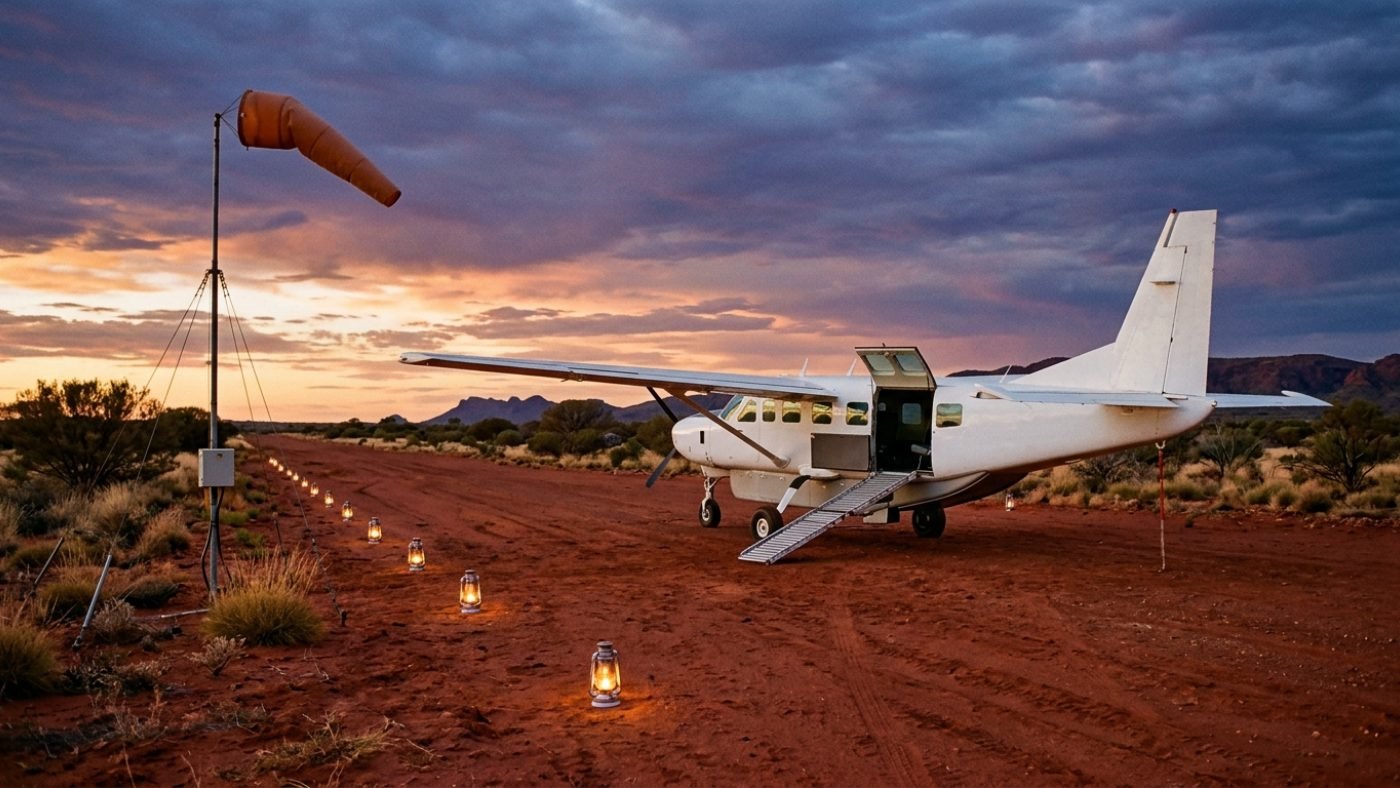
- A windsock.
- Fencing to keep stock off — livestock are, in the RFDS's words, "extremely dangerous to aircraft."
- A surface "which a heavily sprung vehicle can be driven over at a speed no less than 80 kph without undue discomfort."
That last line is the most practical airstrip specification ever written. If it rattles your teeth in the ute at 80, it is not good enough for an aeroplane carrying someone who is dying.
Landing in the dark
Lighting a 1,000 m strip with solar costs up to $26,000, plus $3,000 to $5,000 in maintenance every five years. Most stations don't have that.
So an RFDS Queensland pilot named Nick Tully designed a kerosene lantern kit after LED flares failed him during a night retrieval. Each kit holds 25 lanterns — ten down each side of the runway, two at the end, one spare. They need a match and some fuel. They cost $600 to $800 a kit, and they can be seen from the air up to 48 kilometres away.
The medical chest
This is the quiet masterpiece of the whole system.
A medical chest is a grey enamelled steel box with a lockable lid, holding five closely packed trays and more than 86 items: prescription pharmaceuticals plus bandages, dressings, syringes, needles, a scalpel, scissors, a kidney dish, a urinary catheter, a first aid manual, even an instructional video on intramuscular injection.
To qualify you must be more than 80 km from professional medical care, living and working in the same place for more than six months, and able to reach the RFDS by phone. Chests sit in homesteads, roadhouses, national parks, Indigenous communities, schools, mine sites and offshore vessels. Western Australia alone has more than 600.
The clever part is the numbering. Every item is identified by a number rather than a name. A doctor on a poor radio link does not have to spell out a drug name that might be misheard, or worry that the packaging has changed since the chest was packed. They say a number. The person at the other end opens that compartment.
No training is required to hold a chest. The restricted drugs may only be used on the advice of an RFDS doctor, and holders are asked to check monthly, or at minimum quarterly, for expired items.
In Queensland between July 2005 and June 2006 — the most detailed published breakdown we could find — there were 21,470 telehealth consultations, and chest items were prescribed in 2,938 of them, about 13.7%, dispensing 8,607 items. Most were antibiotics (26%), analgesics (23%) and gastrointestinal medications (12%).
The aircraft, and why those ones
| Type | Number | Range | Why |
|---|---|---|---|
| Pilatus PC-12 | 36 | 2,889 km | The all-rounder — capacity, speed and rough-strip performance |
| Pilatus PC-24 jet | 5 | 3,610 km | Three stretchers, unsealed strips as short as 800 m, halves flight times |
| King Air B200/B200C | 27 | 2,700 km | Two stretchers, three seats |
| King Air B300/B350 | 11 | 3,000 km | Longer legs |
| King Air 360 | 3 | 3,345 km | Newest of the fleet |
| Airbus EC145 helicopter | 2 | — | WA partnership, hospital-to-hospital |
The service uses what it calls a doughnut model: helicopters within roughly 130 miles of major centres, fixed-wing beyond that, where speed and payload matter more than the ability to land anywhere.
Who pays
The Australian Government has committed more than $1 billion over ten years, including $74.8 million as an immediate investment, covering primary care, mental health and dental services in remote communities. A further $29.1 million was announced in March 2024, plus $1 million for a permanent healthcare hub at William Creek in South Australia. South Australia signed a $509.4 million ten-year contract in October 2024. New South Wales added $15 million in June 2025.
But it does not run on government money alone. RFDS South Eastern Section reports that approximately half its funding comes from donations, gifts, bequests and its own initiatives. Western Operations raised $20.4 million in 2023-24 through fundraising, bequests and corporate partnerships, including a record $1.2 million on Flying Doctor Day alone.
The reason it needs that money is straightforward: a flying intensive care unit costs more than $12 million.
One caution if you go looking for a tidy national split between government and donations — there isn't one published. The RFDS is a federation of seven separate legal entities with separate accounts.
What's happening now
The RFDS took delivery of its first Pilatus PC-12 PRO on 5 March 2026 at Alice Springs, the first of five on order at about A$60 million. It was formally launched on 22 June 2026 at the Adelaide base, with twelve aircraft to be delivered nationally over two years, taking the fleet past 100.
It is the first version of the aircraft in the world fitted out for aeromedical work, with Safety Autoland, Smart Glide, improved stall protection and synthetic vision for night and poor-weather flying. It needs only 758 metres of runway and works off unpaved surfaces.
A new $21 million aeromedical hub at Launceston Airport is under construction — $15 million Commonwealth, $6 million Tasmanian — replacing a facility dating to 1988, with 62 construction jobs and 41 ongoing positions.
In March 2026, an economic analysis found RFDS Western Operations will deliver $4.1 billion in social value to Western Australians over thirty years — about two dollars back for every dollar invested. It recorded 10,578 patient retrievals in 2025, an average of 29 calls for help every day. The value per remote WA household exceeds $17,000, against a state average of $3,450.
Ninety-eight years
National Flying Doctor Day on 17 May 2026 marked 98 years since Affleck and Welch flew to Julia Creek. The centenary falls on 17 May 2028.
What Flynn built, on the strength of a letter from a man who died in France, is now a service that reaches 900 people a day across the emptiest inhabited country on earth. If you have ever driven past a dirt strip beside a homestead and wondered why it was fenced and mown, that is why.