
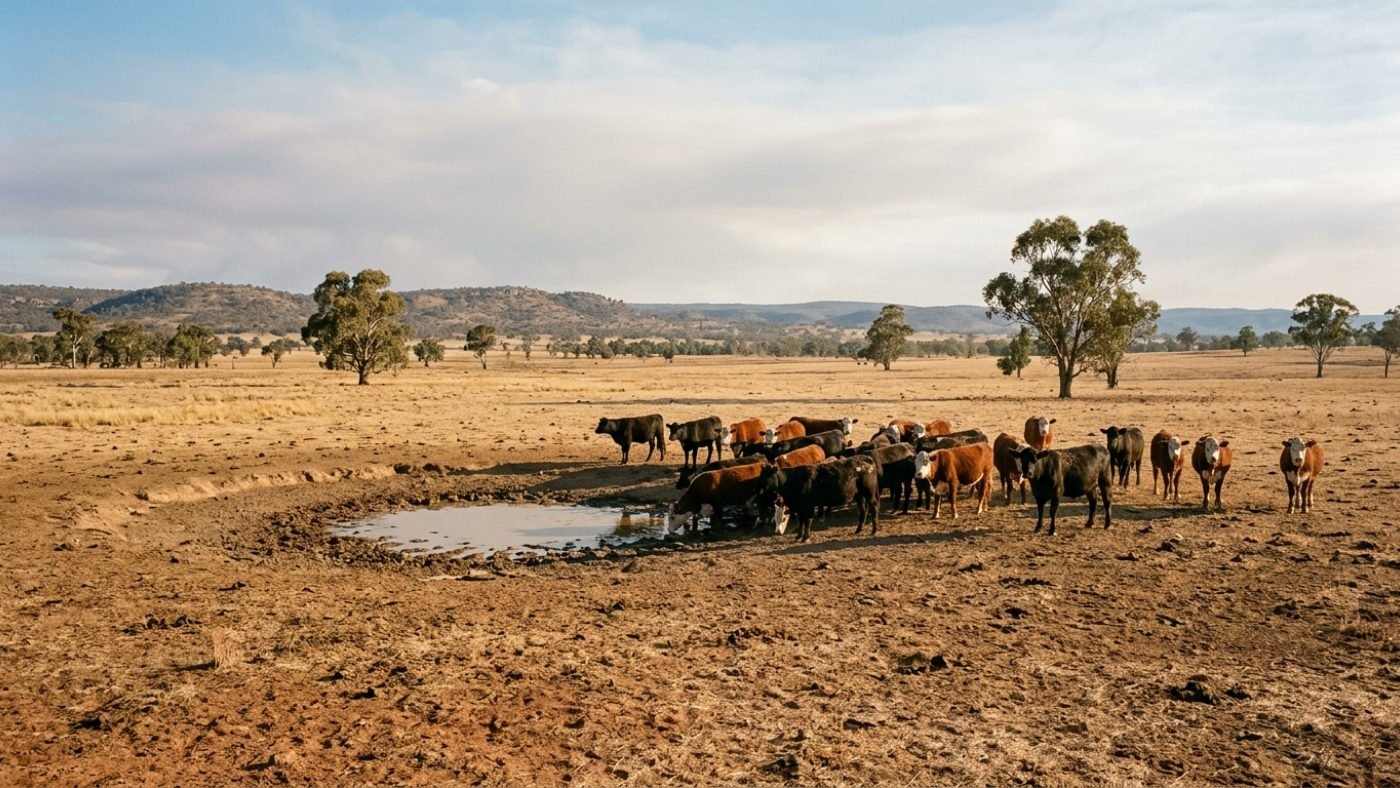
Drought in Australia isn't a weather event. It's a slow financial and emotional siege that can run for years, and the farmers who come through it best are rarely the ones who held on longest — they're the ones who made hard decisions early, while they still had choices.
This is what those decisions actually look like.
The core problem: feed runs out before money does, or the other way round
Every drought decision is a version of one question: do I feed these animals, or do I sell them?
Feeding is expensive and open-ended. Hay prices rise exactly when you need hay most — south-west Victorian pasture hay went from about $260 a tonne in December 2024 to $645 by July 2025, then back to $355 by that October. A 450 kg cow at maintenance eats roughly 7.5–8 kg of hay a day, so the arithmetic turns brutal fast when the price triples.
Selling is painful but final. And the cruelty of it is that everyone reaches the decision at the same time, so prices fall exactly when you're forced to sell — then rise sharply when the drought breaks and everyone tries to restock at once.
The advice every department gives, and few follow: decide your trigger points before the drought, in writing. How much feed on hand, what date, what price — and what you'll do when you hit each. Decisions made in advance are better than decisions made at 2am in year two.
Destocking, in the order it usually happens
Farmers generally shed animals in a considered sequence rather than selling at random:
- Cull the passengers first — empty cows, old cows, anything with bad feet, bad udders or a history of trouble. A drought is a brutal but effective culling opportunity.
- Sell young stock and trading cattle — animals you were going to sell anyway, just earlier and lighter.
- Wean early. Taking calves off cows dramatically cuts the cow's feed requirement and lets you feed the calf a smaller, targeted ration.
- Protect the breeding core last. The genetics of a good breeding herd take years to rebuild. This is the asset you defend to the end.
The alternatives to selling
Agistment — sending stock to graze someone else's country, usually in a region that's still had rain. It keeps the herd intact, but you pay per head per week, you're trusting someone else with your animals, and in a widespread drought the agistment simply isn't available.
Containment or confinement feeding — concentrating stock into a small, sacrificial yard and feeding them there instead of letting them wander a whole property. It looks harsh and it's counter-intuitive, but it's what agronomists recommend, for one reason: it protects the pasture. Cattle spread across a dry paddock eat the last of the groundcover and expose the soil, which means erosion and a much slower recovery when rain finally comes. Sacrificing one paddock saves the farm.
Water becomes its own crisis. Dams go, bores get pushed harder, and carting water is a real and expensive last resort.
What support exists
Australia has moved away from declaring individual districts "in drought" toward standing programs available on need. The main ones worth knowing:
- Farm Household Allowance — a Services Australia payment for farming families in financial hardship, subject to income and asset tests and mutual obligations. It's designed to cover household living costs, not farm costs.
- Farm Management Deposits — a tax mechanism letting farmers set aside income from good years and draw it down in bad ones. Unglamorous, and one of the most effective drought tools available.
- Concessional loans through the Regional Investment Corporation.
- State-based assistance — freight subsidies for fodder and water, rate relief and similar, which vary by state and change between droughts.
- Rural Financial Counselling Service — free, independent financial counselling. Genuinely free, and the people who use it early consistently do better.
Eligibility rules and amounts change, so check the current position with Services Australia and your state department rather than relying on what applied in the last drought.
The charities
Organisations like Rural Aid deliver hay, water, financial assistance and counselling, and BlazeAid rebuilds fences after fire and flood. Farmers are often reluctant to accept help — there's a strong culture of self-reliance — but these services exist precisely for this, and using them isn't a failure.
The part that gets talked about least
Drought is hard on farmers' mental health, and the industry has become far more willing to say so over the past decade. The pressures are specific: financial strain with no end date, isolation, the daily sight of animals and country doing badly, and a strong cultural expectation to cope silently.
The practical advice from people who work in this area is consistent — keep talking to someone, keep some routine that isn't the farm, and treat asking for help as maintenance rather than weakness. The National Centre for Farmer Health and state rural adversity mental health programs exist specifically for farming communities and understand the context. Lifeline (13 11 14) is available at any hour.
When it breaks
Recovery is slower than outsiders expect. Rain doesn't instantly mean grass, grass doesn't instantly mean cattle, and rebuilding a breeding herd takes years — a heifer kept today is a cow producing calves several seasons from now. Meanwhile restocker prices spike, because every destocked farmer is buying at once.
Which is why the farmers who destocked early, banked the money and kept their pasture covered are the ones best placed when it finally rains.
For more on the rhythm droughts interrupt, read a year on an Australian cattle farm, or what life is like on a cattle station.
This article is general information, not financial advice. Program eligibility and amounts change — confirm with Services Australia, the Rural Financial Counselling Service or your state department. If you're struggling, the National Centre for Farmer Health and Lifeline (13 11 14) are there for exactly this.