
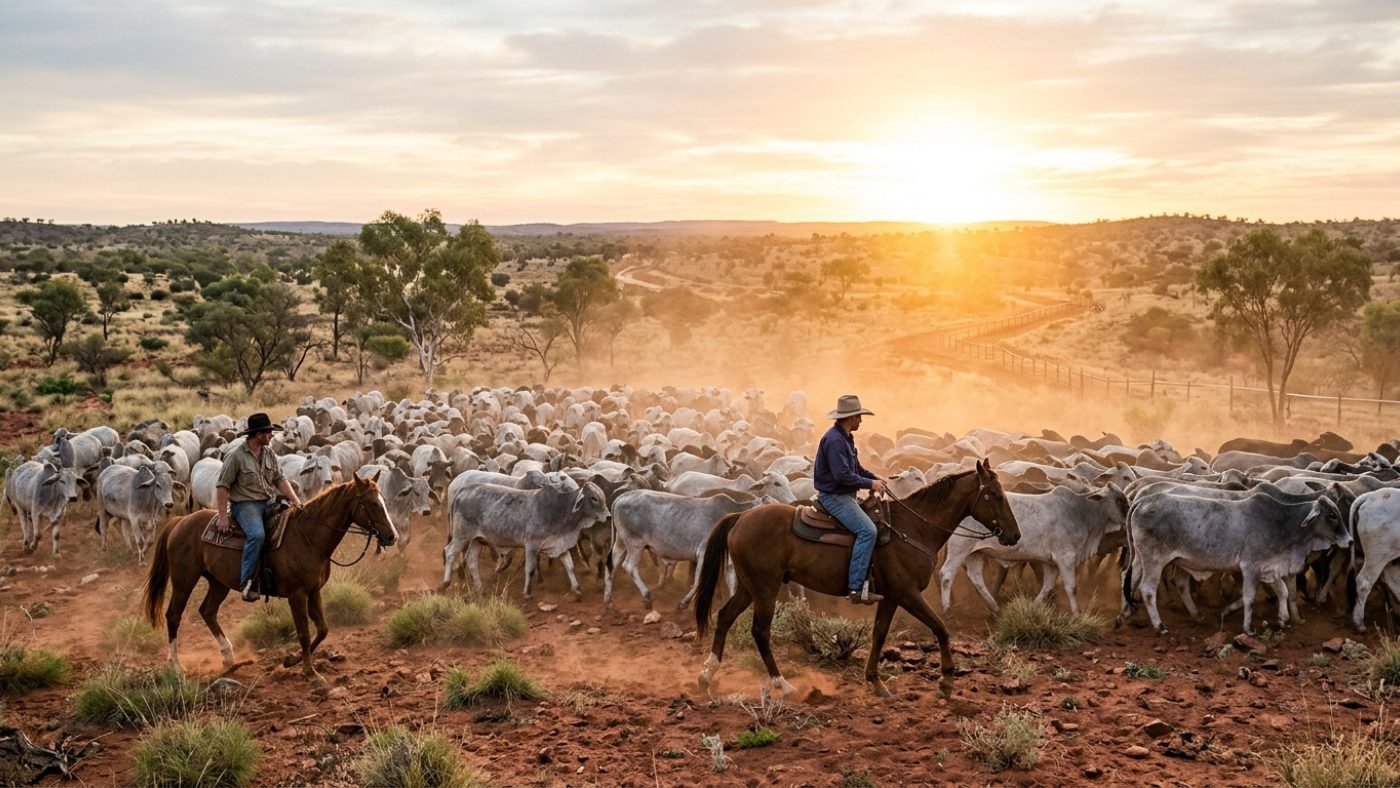
Every autumn, thousands of young Australians decide they want a season on a cattle station, and most of them go about it the same wrong way — firing off identical emails in January and wondering why nobody answers. Station hiring runs on its own calendar, and if you understand that calendar you're most of the way there.
This is the practical version: when to apply, what it pays, what employers actually look for, and what the work is really like.
What it pays, exactly
Station work is covered by the Pastoral Award 2020, so the minimums aren't a matter of opinion. These are the Farm and Livestock Hand rates effective 1 July 2026:
| Classification | Weekly | Hourly |
|---|---|---|
| FLH1 (entry level) | $978.10 | $25.74 |
| FLH2 | $1,004.90 | $26.44 |
| FLH3 | $1,006.80 | $26.49 |
| FLH4 | $1,029.10 | $27.08 |
| FLH5 | $1,046.90 | $27.55 |
Most first-year jackaroos and jillaroos start at FLH1 or FLH2. The jump from bottom to top of the scale is only about $69 a week, which tells you something worth knowing early: on a station you don't get rich by climbing the award, you get ahead by acquiring tickets and becoming the person who can do the jobs nobody else can.
The "keep" deduction. Nearly every station provides accommodation and meals. The award allows the employer to deduct $165.86 per week for keep — and that is the only standard deduction permitted for board and lodging. In exchange the award requires "good and sufficient living accommodation" and "good and sufficient rations… sound, well-cooked and properly served." If you're being charged more than that figure, or the food and housing are genuinely substandard, something is wrong.
The upside people underestimate: with rent and food handled, and essentially nowhere to spend money, a season on a station is one of the few jobs in Australia where a twenty-year-old can genuinely bank most of their income.
When stations actually hire
The northern season is the one that matters for most first-timers. Work runs through the dry, roughly May to October, and hiring happens before that — the bulk of it from about January to March. By the time the season is underway, the crew is full.
Southern properties are less seasonal and hire more opportunistically through the year. If you've missed the northern window, look south, or look for mid-season replacements — people do leave, and a station short-handed in July is far less fussy than one recruiting in February.
What actually gets you hired
Managers are hiring for reliability, not romance. In rough order of how much they move the needle:
- A manual driver's licence. Close to non-negotiable. Almost every vehicle on the place is manual, and a hand who can't drive one is a hand who needs driving around.
- Any truck licence. An HR or MR licence makes you immediately more useful and is one of the fastest ways to move up the pay scale.
- Genuine willingness to start at the bottom. Your first weeks will involve fencing, troughs, gates and cleaning. People who treat that as beneath them don't last.
- Basic mechanical sense. You don't need to be a diesel fitter, but being able to change a tyre, jump a battery and diagnose a dead pump is worth a lot when the nearest workshop is 300 km away.
- Horse or bike experience — useful, but far less essential than people assume. Plenty of good stockmen learned on the job.
- First aid certificate. Cheap, quick, and it signals you've thought about working somewhere remote.
What matters more than any of it: turning up on time, doing what you're asked without an argument, and not being precious. Managers say some version of this in every interview they give.
How to actually apply
Cold-emailing a generic CV to fifty stations is the least effective method, and it's what most people do. Better approaches:
Ring, don't just email. Station managers are not sitting at a desk refreshing their inbox. A short, polite phone call in the evening lands better than a dozen emails.
Go through the recruiters and industry channels. There are agencies that place station staff every season, and industry Facebook groups where jobs get posted and filled within days. Being in those groups from January is worth more than any CV polish.
Say where you're from and what you can already do. A manager reading "I have a manual licence, I've done fencing, I'm available May to October, I'm not scared of early starts" learns more than from a page of adjectives.
Be honest about experience. Claiming you can ride when you can't gets discovered on day two, in front of everyone, possibly with an ambulance involved.
Working holiday visas
Station work has long been one of the ways backpackers on a Working Holiday visa (subclass 417 or 462) qualify for a second or third year through "specified work" in regional Australia. The rules around eligible work, locations and evidence do change, and getting it wrong costs you a visa year — so check the current requirements directly with the Department of Home Affairs before you rely on a job counting, and keep your payslips and employer details from day one.
What to bring, and what it's actually like
Kit is unglamorous: solid boots you've already worn in, a wide-brim hat, long-sleeved work shirts, a swag, a decent torch, and more sunscreen than you think. Leave the new gear at home; nothing marks a newcomer like spotless boots.
Expect early starts, long days in the dry season, and a roster that bends around mustering rather than around weekends. Phone signal is often limited to one spot near the homestead. You'll live and eat with the same handful of people for months, which is either the best part of the job or the hardest, depending largely on your attitude.
Know your rights. The Pastoral Award sets minimum pay, overtime, leave and the keep deduction. Underpayment does happen in this industry, usually to young or overseas workers who don't know the rates. Keep your own record of hours worked. If something doesn't add up, the Fair Work Ombudsman handles exactly this, free, and you can contact them anonymously.
Is it worth it?
Financially, for a season, yes — few other entry-level jobs let you save most of what you earn. Beyond that, people who've done it tend to talk less about the money and more about what it taught them: how to work, how to be useful, and how to get along with people you can't get away from.
If you want a clearer picture of the life before you commit, read what it's really like living on a cattle station.