
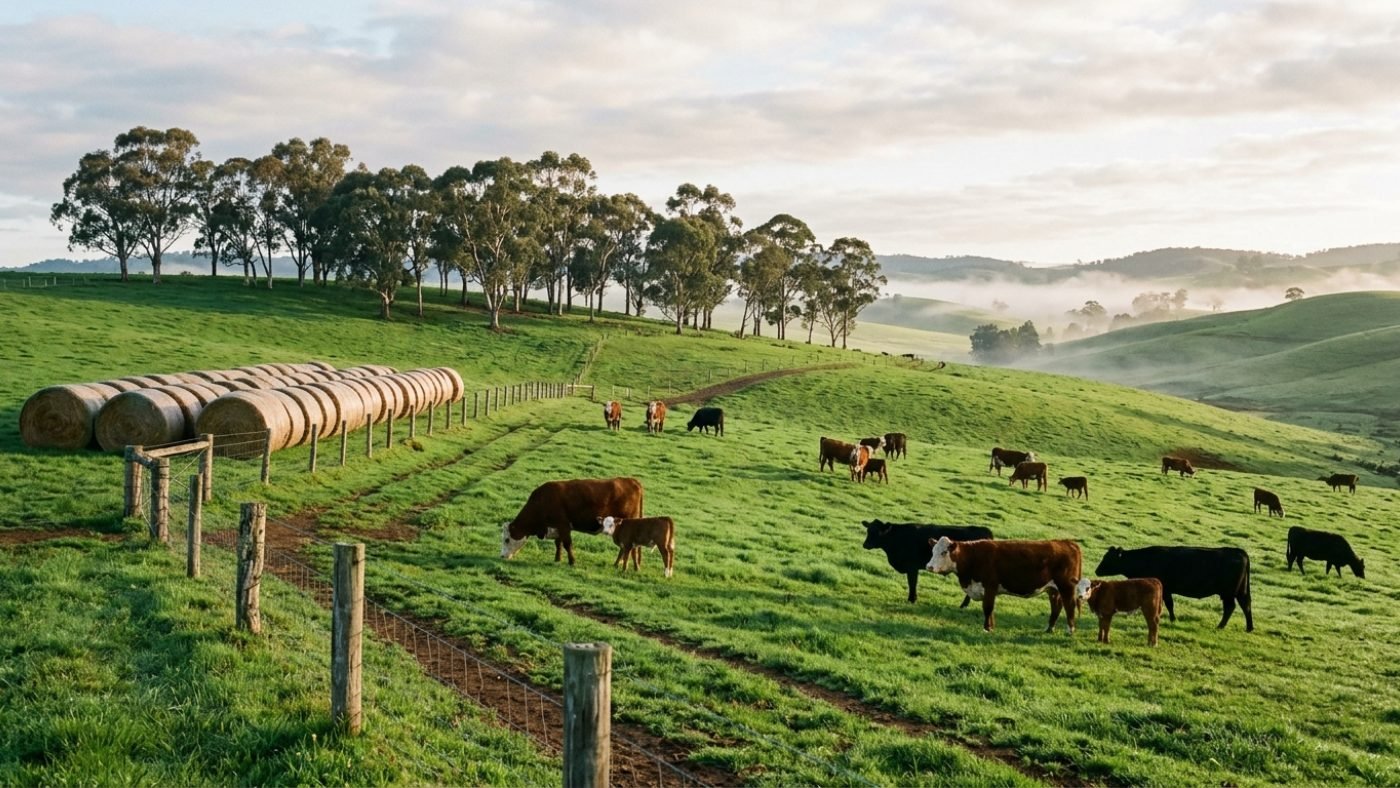
People imagine farming as one long continuous activity — feeding animals, checking fences, repeat. It isn't. A cattle year has a structure as fixed as a school timetable, and almost everything a farmer does is dictated by where the herd is in its breeding cycle and where the country is in its growing season.
Here's that year laid out. The months below suit southern Australia, where the seasons are the familiar four. Northern Australia runs on a different clock entirely, and we'll come to that.
Spring — September to November
The busiest, best-smelling part of the year. Grass comes away, and after months of rationing feed there is suddenly more of it than the herd can eat.
For spring-calving herds, this is calving — the defining event of the farming year. Cows are checked at least twice daily, difficult births assisted, and newborn calves watched for the first feed of colostrum. It is broken sleep and high stakes; a calf lost at birth is a year's production gone.
Alongside that: pasture is at its most productive, so surplus grass gets shut up for hay and silage to feed the herd through the next dry spell. Weeds get sprayed while they're actively growing. Fertiliser goes on. Everything happens at once.
Summer — December to February
The season that punishes poor planning. Pasture dries off and stops growing, so the herd starts eating into what spring produced.
Water becomes the daily preoccupation. Troughs, pumps and float valves are checked constantly, because a failure in February is measured in hours, not days — cattle in hot weather can need up to 250 litres a head per day. Shade matters. Working cattle gets pushed to early morning, since yarding animals in the heat of the day is hard on them and on the people.
Hay made in spring starts being fed out. Calves born in spring are growing fast, and this is typically when weaning happens — separating calves from their mothers, which is noisy for about three days and then quiet.
Fire. Through summer, farms in most of southern Australia operate under fire restrictions. Slashing, welding and anything that throws a spark becomes a scheduled, checked activity rather than a casual one. Firebreaks get maintained, water points kept accessible, and plans rehearsed. It sits over the whole season.
Autumn — March to May
The strategic season. The autumn break — the first proper rain after summer — is the moment the year turns, and farmers watch the forecast with an attention that looks obsessive from outside. Whether it comes early or late shapes the following twelve months.
This is when the big decisions get made. Joining (putting bulls with cows, or arranging artificial insemination) happens now for spring calving, since gestation runs roughly nine months. Pregnancy testing from earlier joinings tells you which cows are earning their keep and which aren't.
It's also the main selling window for many operations — moving young stock before winter feed costs kick in. And it's when the honest assessment happens: how many animals can the farm carry through winter on the feed it actually has? Getting that number wrong is the most expensive mistake in cattle farming.
Winter — June to August
Cold, wet and slow-growing. Pasture barely moves, so the herd is largely fed on conserved hay and silage. A cow in cold weather needs more feed, not less — roughly 20% above maintenance — which surprises people who assume animals eat less when they're not growing.
Mud becomes the enemy: pugged paddocks, bogged vehicles, and cattle standing in wet ground. Stock get moved more often to spare the worst areas.
But winter is also the maintenance season, and that's genuinely useful. Fences get rebuilt, yards repaired, machinery serviced, paperwork caught up. The jobs that are impossible when you're calving or making hay all happen now. Autumn-calving herds, meanwhile, are doing their calving in the cold — harder on everyone, but it puts weaned calves onto spring grass at exactly the right moment.
The north runs on a different year
Above the Tropic of Capricorn there is no spring, summer, autumn and winter in any useful sense. There is the wet, roughly November to April, and the dry, roughly May to October.
The dry is the working season: mustering, branding, weaning, trucking cattle out. Roads are passable and the country is accessible. The wet shuts much of that down — black-soil roads turn to grease, stations can be cut off for weeks — but it's also what grows the year's grass. A poor wet season means a hard following year, and everyone knows it by February.
Our article on life on a cattle station goes into what that rhythm feels like to live inside.
Why the calendar matters
Two things follow from all this. First, when you buy beef, the season you buy it in reflects decisions made a year or more earlier — the joining, the season, the feed available. Second, if you're thinking of running cattle yourself, the calendar is the plan. Work out what your country grows and when, then fit the herd to it, rather than the other way round.
If that's where you're headed, our guide to what it really costs to keep cattle on a small block puts numbers against every season above.